
Energy, Water and Materials
Although the completed CRL will help reduce Auckland’s carbon footprint, by reducing car use, its construction and operation consumed significant resources.
The project aimed to reduce these impacts as much as possible in order to contribute to regional and national greenhouse gas emission reduction targets.
During the design phase, the team worked hard to optimise resource use for the lifetime of the CRL.
To measure success, total energy, water and materials use was estimated based on the early design ("base case") and the final "detailed design" was compared against it to quantify improvements introduced during the design phase.
Succeeding in projecting reductions for both construction and operation.
In 2022, the CRL was awarded the Decarbonisation Outcome Award (projects over $20m) at the Building Nations 2050 Impact Awards recognising the project for exemplifying climate consciousness and the incorporation of decarbonisation into the project's full life-cycle.
Energy: Pūngao
Whole-of-Life footprint
CRL’s energy footprint was largely comprised of the diesel and electricity needed to construct and operate the stations and tunnels.
The challenge laid down for our main construction partner Link Alliance was to achieve a 25% energy carbon emission reduction compared to a business-as-usual Base Case.
Energy is used during construction for everything from boring piles and transporting excavated spoil to heating water for workers’ tea and coffee.
A saving of just over 36,000 tCO2e of greenhouse gas emissions was expected. This is a 21.4% saving. Around 80% of this saving is expected to be achieved during the 100-year operational phase projected for the stations and tunnels.
The total savings is equivalent to just over 42,000 economy class flights between Auckland and London.
The Chart below shows how these savings were expected to be achieved.
The graph below shows how emissions associated with energy use for Link Alliance contract 3 tracked well below both the base case and detailed design projections.

Electric Multi-Service Vehicles (MSV)

Switching from diesel-power to electricity can reduce emissions by as much as 80 per cent. To make the most of these savings CRL used three electric MSVs with regenerative braking rather than the standard diesel.
These MSVs were used to deliver tunnel segments, equipment and people to the tunnel boring machine. The CRL tunnels were ideal for trying out this new technology, being relatively short with vehicles typically travelling downhill loaded (with 20 tonnes of segments) and uphill empty, thereby utilising regenerative braking for on-the-go charging.
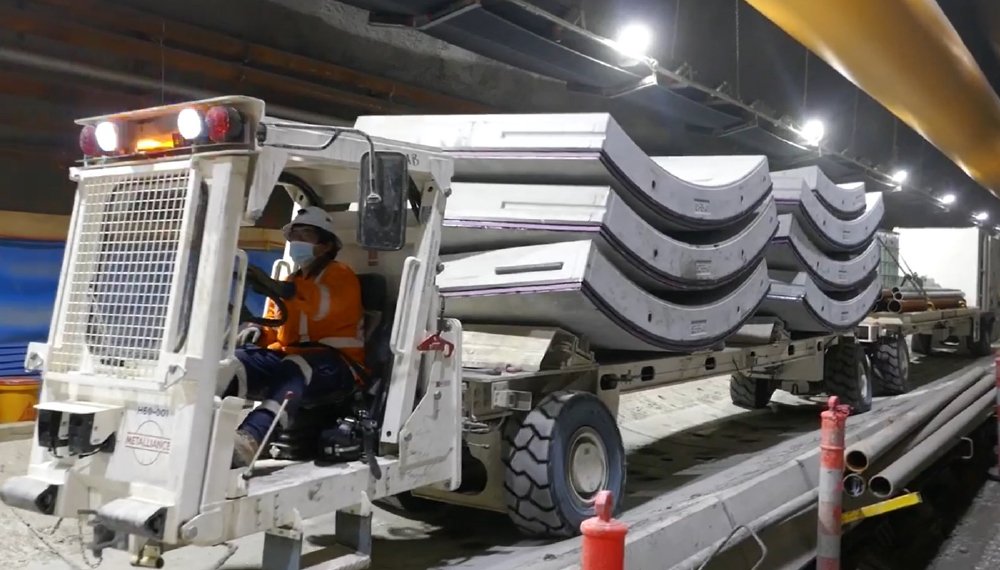
The three electric MSVs saved the project over 200 tCO2e in emissions. With tunnelling completed the machines have been sent back to French manufacturer Metalliance with feedback on performance for use on other projects.
Water: Wai
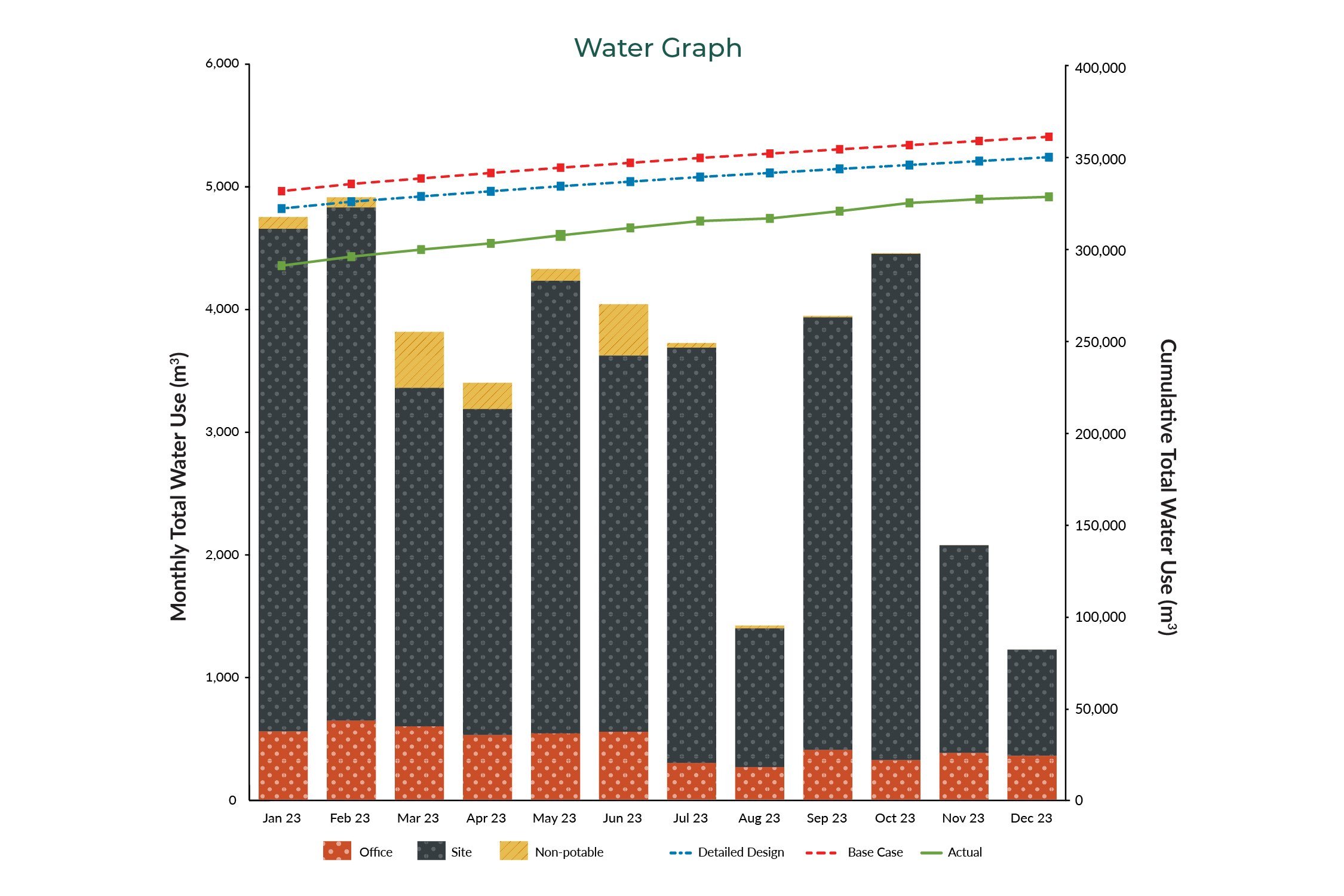
Saving water was a priority for CRL. Water use for both construction and operation of the CRL was projected, and a 5% reduction target set.
Although the majority (82%) of the water used on CRL was during its operation, construction was expected to use more than 340 million litres, with the Tunnel Boring Machine being one of the largest users.
As well as designing the stations to be water efficient, a key approach had been reusing non-potable water (that is not of drinking quality) where possible.
Water Treatment Plants located on CRL sites processed all water collected and ensured it could be safely discharged into the stormwater network. This non potable water and rainwater collected from roofs wasused for:
washing truck wheels before they leave site
cleaning the Tunnel Boring Machine conveyor belt, chute point and washing box
refilling the water carts that spray water on the ground to prevent dust being generated around the site and
other site cleaning.
Materials
Constructing the CRL required significant quantities of materials - particularly concrete and steel - the production of which consumes valuable resources and produces greenhouse gases. The embodied carbon of these materials made up half of the total carbon footprint over the project’s 100-year design life.
Efforts to minimise this embodied carbon continued through from the design phase into construction where the team continues to look for ways to reduce these impacts.
The total reduction in the materials carbon footprint for each of the three main contracts was projected to be:
Contract 1: Embodied Carbon: 13,109 tCO2e (14%)
Contract 2: Embodied Carbon: 12,664 tCO2e (37%)
Contract 3: Embodied Carbon: 24,279 tCO2e (15.8%)
Main project partner Link Alliance’s (C3) target was to reduce embodied carbon by 15% against the base case design.
Reductions resulted from:
Maximising cement replacement in concrete mixes
Redesign of the Karanga-a-Hape Station to remove the central mined walkway
Reducing the area of materials-intensive mined tunnels at Maungawhau Station
Change from piles to diaphragm walls (D-walls) across large parts of the project
Change from bottom-up to top-down construction across the project, reducing the need for temporary steel propping
Optimisation of the large retaining walls needed at the North Auckland Line connection.
FLY-ASH
A key construction-phase initiative had been reducing cement use in concrete. Cement has a high embodied carbon footprint of almost one tonne for every tonne used. Since construction started, the team maximised cement replacement with fly-ash, a waste product from coal-fired power stations, with a much lower embodied carbon.
This allowed the main Link Alliance contract to eliminate 18,444 tCO2e, a 21.4% reduction to the end of 2022. Covid-19 impacts to the supply chain, especially international shipping, made sourcing fly-ash more difficult, with the project having to ration its use at times.
50MM REINFORCING BAR
Earlier initiatives included the production of 50mm reinforcing bar for the first time in New Zealand.
Changing from contiguous piles to diaphragm walls underneath Britomart Station reduced steel use during the design phase and also reduced the time and cost of the station underpinning.
Due to the depth of the rock under the station (around 20m), using 40mm reinforcing bar (the largest size available in New Zealand at the time) would have resulted in reinforcing bar “congestion”, preventing the concrete properly flowing around the bars to form the diaphragm wall.
Fewer, but larger, bars were required. These had not been made previously in New Zealand. Contractor DSBJV worked with local manufacturer Pacific Steel in Otahuhu, which uses steel from the Glenbrook steel mill 40km east of Auckland, to fabricate New Zealand’s first 50mm reinforcing bar.
Besides improving constructability, using this larger diameter steel reduced the total weight of steel required by about 82 tonnes, lowering associated greenhouse gas emissions by just over 100 tCO2e.
It also reduced the transport emissions and costs associated with sourcing it offshore.