

Quick links…
Leadership succession
One million trips
Big numbers explore CRL
Thousands on the first day
New transport era begins
Successful morning peak
CRL starts on the 13th
Day 1
Final emergency test
Opening announcement
City Rail Link features in Architecture Aotearoa
First Looks
CRL stations blessed
Drury stations open
City emergency testing
April closures explained
April closures
Karanga-a-Hape Station improvements
Last train arrives
First neighbourhood complete
Region-wide train testing
Rail closures ahead
Light at the end of the CRL tunnel
Albert St re-opens
5G in the tunnels
CRL testing signals what’s coming
Labour weekend work
Beresford Square returned
PM takes a test train
Double bonus for remarkable achievement
Matariki weekend closure
Successful test train
First train tonight
Welcome to the CRL Media Centre where you will find our latest media releases, our responses to media queries and who to contact if you have a media inquiry.
To contact CRL, go here but for media queries 021 567 862
Where to find previous news releases:
2026-2025 News Releases
Leadership succession at City Rail Link
Friday 2 October 2026
Following the successful completion and opening of Auckland's City Rail Link (CRL) – New Zealand's biggest transport project – Patrick Brockie is stepping down as City Rail Link Ltd's (CRL Ltd) Chief Executive to be succeeded by Emma Kurtovich as the company's Executive General Manager.
Mrs Kurtovich is presently CRL Ltd's General Counsel and Company Secretary. She will lead CRL Ltd through its final stages of project close-out.
"This next chapter for CRL is about building on the outstanding work that has gone before and completing CRL Ltd’s remaining obligations with focus and discipline,” Mrs Kurtovich says.
“These past five years with CRL Ltd have been the most rewarding of my career. I have had the privilege of working alongside talented people across an extraordinary range of disciplines and have learnt a huge amount. Seeing Aucklanders move through and enjoy the completed stations and tunnels - and knowing that I have played a part in this city shaping project - is something I am immensely proud of."
Mrs Kurtovich has extensive construction and infrastructure experience. Before joining CRL Ltd, she worked in the tier one construction and infrastructure disputes practice at Herbert Smith Freehills LLP in the United Kingdom and before that in the construction and infrastructure division at MinterEllisonRuddWatts legal firm in Auckland.
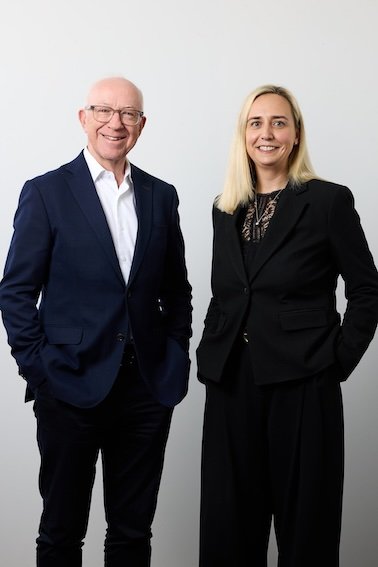
Outgoing Chief Executive, Patrick Brockie, says with the City Rail Link now open, the time felt right for him to step down after more than seven years. “It has been a genuine privilege to lead CRL Ltd and see this once-in-a-generation project through to opening. I am proud of the many people who made it happen and extend my sincere thanks to the CRL Ltd team, project partners, contractors and stakeholders for their extraordinary commitment and perseverance,” says Patrick.
CRL Ltd’s Chair, John Bridgman, paid tribute to Mr Brockie, describing his contributions first as Chief Financial Officer and then as Chief Executive as integral to achieving CRL's practical completion on 30 June 2026.
“Pat stepped up to lead CRL Ltd at a critical time when we were embarking on the most important phases of the project - testing and commissioning – and he has achieved a fantastic outcome for Auckland. Working in close collaboration with Auckland Transport and KiwiRail was essential to this."
Mr Bridgman will welcome Mrs Kurtovich to the Executive General Manager role on Monday 12 October and says her combination of project knowledge, commercial judgement, governance expertise and strong stakeholder relationships positions her well to help lead the company through the final phases of the project.
One million trips and counting - Hon Chris Bishop
30 September 2026
More than one million train rides have been recorded on Auckland’s rail network in the first two weeks since the City Rail Link (CRL) opened, with early data showing Aucklanders are embracing new routes and changing the way they travel across the city, Transport Minister Chris Bishop and Auckland Mayor Wayne Brown say.
“More than 506,000 train boardings were recorded in the second week of the CRL, taking the total number of boardings since opening to more than one million,” Mr Bishop says.
“That continues to beat the previous record for weekly boardings, set in March 2019. That record was smashed in CRL’s first week, when 528,007 boardings made it the busiest week in the history of Auckland’s rail network.
“Aucklanders are quickly adapting to the new network, with West Auckland leading the charge. Average daily trips between western stations and the city centre have increased by almost 173 per cent compared with the six weeks before the CRL opened. That’s an extra 7,600 trips per day.
“Seven of the 10 stations recording the biggest growth in passenger numbers are along the former Western Line, while journeys between Auckland’s western and eastern rail corridors have tripled.
“This data demonstrates that faster journey times and new direct connections are making rail a much more attractive option for trips that were previously slower or required people to change trains.”
Mayor Wayne Brown says Aucklanders are quickly taking advantage of the new connections created by the CRL.
“The city centre is a clear example of how commuters are responding to the new network. Weekday boardings at city centre rail stations have increased by 87 per cent, with Te Waihorotiu and Karanga-a-Hape already becoming the second and third busiest stations on the network, behind Waitematā,” Mayor Brown says.
“We’re also seeing nearly 6,000 trips a day between city centre stations themselves. I’ve already taken the CRL seven times since it opened.
“At the same time, patronage on the City Link bus service, which traditionally connects Wynyard Quarter, Queen Street and Karanga-a-Hape, has fallen by 17 per cent.
“That shift shows Aucklanders are changing their travel habits and choosing rail for journeys where the new network has made it a quicker and easier option.
“The same pattern is evident across the wider network. Train boardings are up 22 per cent at Panmure and 33 per cent at New Lynn, both major bus-train interchanges.
“Bus patronage overall remains strong, with more than 237,000 bus boardings recorded on an average weekday during the first two weeks of the new rail network, as Aucklanders make full use of the wider rapid transit network and transfer between buses and trains – taking advantage of the better connections now available across the city.”
Mr Bishop says the benefits are also being seen in south Auckland.
“Trips between stations south of Puhinui and the new CRL stations have increased by almost 30 per cent compared with pre-CRL travel patterns.
“Across Auckland, we’re seeing people make use of journeys that the old network simply couldn’t offer. People are travelling west to east, taking direct trains into the city centre, using rail to move around the city centre, and connecting between buses and trains.
“The CRL has transformed what Auckland’s rail network can do. Two weeks in, Aucklanders are already changing the way they travel to make the most of it.”
Older Aucklanders exploring new rail network in big numbers
15 September 2026
As Aucklanders boarded trains on our city’s new rail network an estimated 90,000 times on Monday, Auckland Transport (AT) noticed a big uptake in SuperGold card holders making the most of the City Rail Link.
Monday was the first real weekday test of Auckland’s new train services, City Rail Link infrastructure and new train stations, with the system rising to the challenge.
AT Chief Executive Stacey van der Putten says Monday was a fantastic day for the rail network with a big boost in passenger numbers.
“We had a great day on Sunday getting Aucklanders onboard our new rail network and showcasing the City Rail Link and our incredible new train stations,” Ms van der Putten says.
“On Monday Aucklanders stepped things up a level, with an estimated 90,000 train boardings across the day which is about 55% higher than what we saw last Monday.
“It was great to see so many people using the network to get to work, school and university during our peak commuter period but the biggest change came during the day.We actually saw the biggest percentage increase in people travelling on the rail network in between our peak periods, with SuperGold card holders leading the charge.
“Our early data suggests SuperGold Card holders took about 130 percent more trips yesterday than last Monday, followed by tertiary students and Community Connect users who took about 60 percent more trips.
“This lines up with what our teams on the ground have been seeing, which is that Aucklanders of all ages, and from all across the city, are getting out to make the most of our new rail network.”
Early data shows Tuesday rail use also well up
Estimates from Tuesday’s morning peak period also shows train use well up on last week, with about 44,000 boardings by midday today – compared with 30,000 at the same time last Tuesday.
Train services continued to run smoothly this morning, with reliability across the network sitting at about 97% for the morning peak, with 99% of services reaching their destination within 5 minutes of schedule.
Tens of thousands of Aucklanders embrace CRL on its first Monday of operation
14 September 2026
The first weekday commute using City Rail Link (CRL) services has proven to be a game changer for how Aucklanders get around their city.
As of 5pm this evening, an estimated 72,500 boardings were counted on trains across the network, which is 25,000 more boardings than were recorded on the train network by the same time last Monday.
“What we’ve seen today is not only a busy morning peak period with customers heading into work, school or university, but numbers have stayed strong throughout the rest of the morning and afternoon too,” says Stacey van der Putten, AT Chief Executive.
“This shows Aucklanders are getting out there and exploring the new routes that CRL offers, and it’s a fantastic new way for people to visit parts of the city they may not have had easy access to in the past.
“Our ambassador staff have been supporting customers at Karanga-a-Hape and Maungawhau stations throughout the day to transfer from the East-West to the South-City or Onehunga-West lines. These transfers will become second nature to Aucklanders in the weeks to come.”
AT partners Auckland One Rail have released some key statistics. It says a total of 84 trains are in service today operated by 200 drivers and supported by 150 train managers.
Over 100 customer service staff and ambassadors have been at stations helping people with travel and transfer information, and more than 100 security staff have also been present.
Successful morning peak as commuters flock to trains
14 September 2026
Aucklanders have continued to make the most of the city’s new rail network this morning as commuters and students travelled on through the City Rail Link to work, school or university for the first time.
Early data shows Aucklanders have travelled onboard Auckland Transport’s trains 25% more already today than by this time last Monday. By 9am, sensors onboard AT’s trains had picked up about 24,000 people getting onboard, compared with 19,000 last Monday.
Train services have been running smoothly this morning. The first train service was a South-City Line train which departed Pukekohe at 5.06am and arrived at Karanga-a-Hape at 6.15am.
So far today our trains have run at a punctuality rate of 99%, which measures how many trains arrive at their destination within five minutes of the scheduled time.
To help Aucklanders get used to their new train network, Auckland Transport has had teams based at stations across the network, with a particular focus on Karanga-a-Hape and Maungawhau stations to support passengers transferring from the East-West to the South-City or Onehunga-West lines.
Sunday 13 September: the day Aucklanders rode the train
Early estimates suggest yesterday was the busiest ever Sunday on Auckland’s rail network. about 70,000 people were recorded stepping through the doors of Auckland’s trains throughout the day – at least three times more than the previous Sunday.
This data suggests there were a lot of Aucklanders getting on and off trains to experience the City Rail Link and new stations, rather than travelling from A to B. It was great to see so many people on the network.
Karanga-a-Hape was the busiest new train station, followed by Te Waihorotiu and Maungawhau. Waitematā Station was also busy throughout the day and was a popular point for people to start and finish their train adventures.
New era of transport in Auckland begins
13 September 2026
Aucklanders have travelled through the heart of the city by train for the first time today, as passenger services began on the City Rail Link-enabled rail network
From before dawn, hundreds of train enthusiasts queued across the network to be among the first customers to experience New Zealand's first underground railway and the biggest transformation of Auckland's rail network in generations.
More than 400 people made the journey to Ōtāhuhu Station to hop onboard the very first passenger train through the City Rail Link tunnels, travelling from as far as Cambridge and Lower Hutt.
23-year-old Taylor hopped in an Uber from Drury to be the first person in the queue at Ōtāhuhu Station, waiting from 3.40am to be onboard the historic first ride.
“It’s exciting to see Auckland’s future coming to fruition – seeing us finally having a true underground system and a truly modern heavy rail suburban network.
“It’s definitely worth getting up early for.”
The first train to arrive at a new City Rail Link station was a South City Line service which travelled from Ōtāhuhu at 4.57am, pulling into Karanga-a-Hape Station on-time at 5.22am before carrying on to Te Waihorotiu and Waitematā stations.
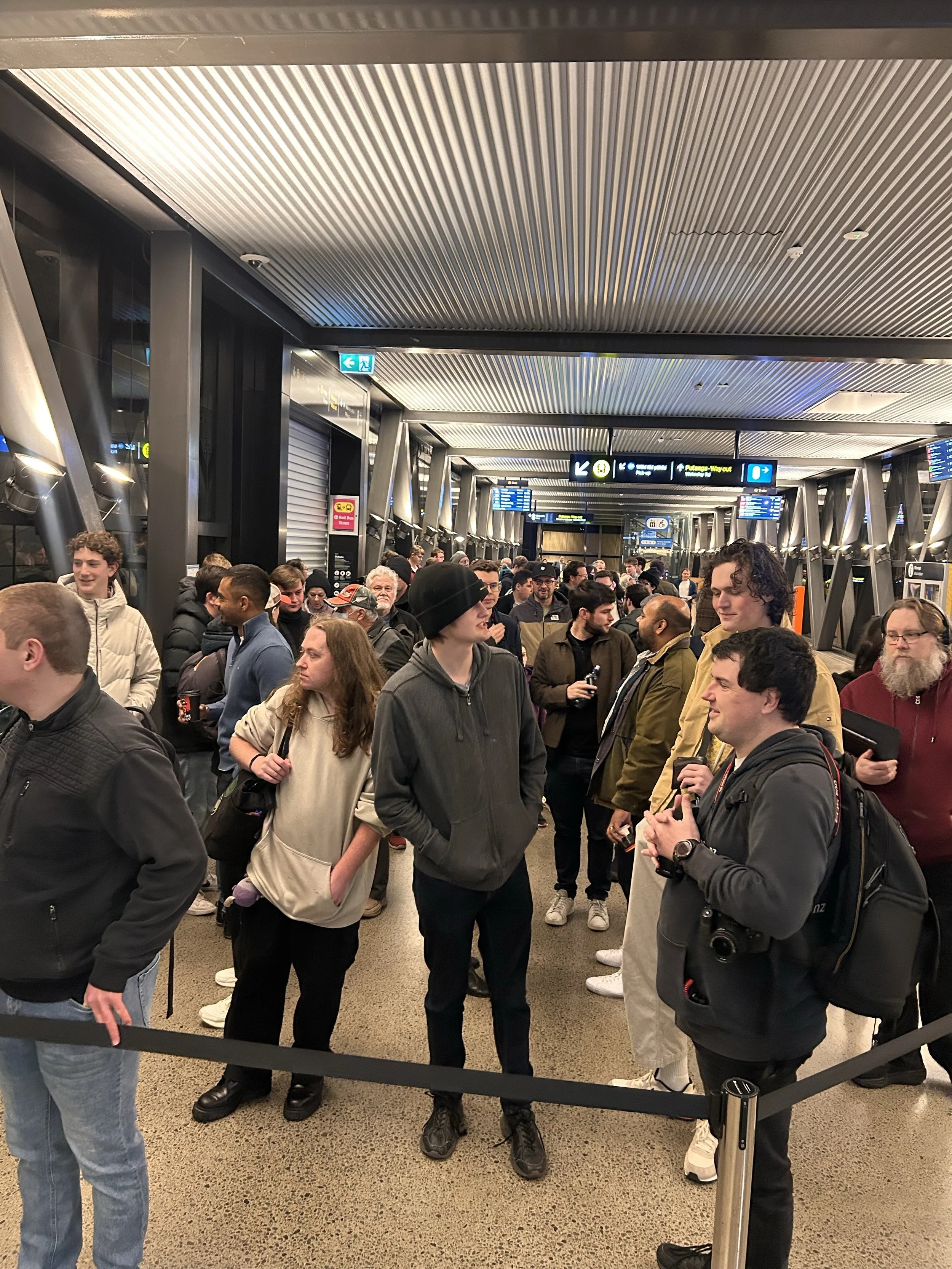
For avid train photographer Alex, catching the first train was worth the early start.
“I’m excited to see Auckland’s rail network expand through the city centre properly as well as having much more frequent trains throughout the whole rest of the network.”
Families, elected members and people who helped design, build, test and prepare the City Rail Link were also among those eager to experience the new network on opening day.
This morning we estimate we have already carried more than double the number of passengers we did this time last Sunday, with about 14,300 people having travelled across the rail network so far today compared with 6,800 by this time last Sunday.
The opening marks the culmination of one of the largest operational changes undertaken on Auckland's public transport network, bringing together the efforts of City Rail Link Ltd, Auckland Transport, KiwiRail and Auckland One Rail to prepare the railway for service, underpinned by funding, direction and oversight from the Government and Auckland Council.
Auckland Transport’s Chief Executive Stacey van der Putten was onboard the first train and says it was a joy to finally see Aucklanders enjoying the benefits of the new network.
“For years Aucklanders have watched the City Rail Link take shape beneath the city. Today they finally got to experience it for themselves.
“I loved seeing the smiles on people’s faces and just how many people wanted to be part of this historic moment. The excitement across the network has been incredible to be a part of.
"I can’t wait to see how they make our new rapid transit network their own in the weeks, months and years ahead, taking advantage of the easier connections to people and places.”
The City Rail Link introduces two new underground stations at Karanga-a-Hape and Te Waihorotiu and enables a redesigned rail network and increased capacity across Auckland's rail system.
Three new lines, the East-West, South-City and Onehunga-West, offer customers better connections and more ways to connect with people and places across Auckland.
KiwiRail Chief Metro Officer Bevan Assink says the day was significant for everyone involved and personally rewarding.
"Thousands of people have poured their heart and soul into this project. Seeing first-hand trains carrying customers through the City Rail Link and witnessing Auckland's new rail network come to life was a bit emotional.
"Our teams will continue working around the clock to support the safe and reliable operation of the rail network as Aucklanders begin making the most of this new way of travelling around the city."
Customers across the network were welcomed by ambassadors helping people navigate the new stations, services and connections. Free coffee, live entertainment and opening-day activities added to the celebratory atmosphere.
Monday 14 September will see the introduction of the first weekday timetable operating through the City Rail Link, with trains running every four to five minutes through the new stations during peak periods.
Auckland Transport is encouraging customers to use the Journey Planner and familiarise themselves with the new rail network and its connections to the wider public transport system before travelling.
Passenger Services set to begin in two days as the City Rail Link formally opens
11 September 2026
After years of planning, construction and preparation, the countdown is almost over. This Sunday, the City Rail Link (CRL) will become part of everyday life, ushering in the biggest transformation of Auckland's rail network in generations.
Ahead of the start of passenger services, Prime Minister Christopher Luxon, Auckland Mayor Wayne Brown, ministers, councillors and mana whenua formally opened the City Rail Link on Friday, celebrating New Zealand's largest ever infrastructure project.
The City Rail Link creates a new rail network in Auckland, with new stations, new train routes and a new timetable that will connect more Aucklanders to more destinations across Tāmaki Makaurau.
Today is the beginning of a new chapter. We're incredibly proud of what has been achieved and are excited to welcome Aucklanders aboard,” says Auckland Transport Chief Executive Stacey van der Putten.
Our focus now is on helping customers confidently navigate the new network and delivering the safe, reliable service Aucklanders expect. Significant interest is expected on opening day as Aucklanders experience the City Rail Link for the first time. We encourage people to familiarise themselves with the new rail network and how it connects with the wider public transport system before travelling."
The launch of passenger services will represent one of the largest operational changes ever undertaken on Auckland's public transport network, drawing on more than a decade of planning, delivery and preparation by City Rail Link Ltd, Auckland Transport and KiwiRail to prepare the railway for service.
“The City Rail Link is one of New Zealand's most ambitious infrastructure projects,” says City Rail Link Limited CEO Pat Brockie.
“Today was a chance to reflect and recognise the thousands of people who have helped bring it to life. What Aucklanders will experience on Sunday is the result of years of engineering, construction, testing and collaboration. We are incredibly proud of the part we played and are excited to see it ready to serve Auckland for generations to come."
In recent months, the focus has been on the extensive testing of trains and systems in the new tunnels and stations as well as preparation for frontline staff involved in implementing and running an entirely new train network.
Maintaining Auckland's existing rail services while building and integrating an entirely new underground railway, along with widespread network upgrades and new rail infrastructure has been a significant undertaking.
"Customers will see new stations and new journey opportunities, but behind the scenes there has been an enormous amount of work to ensure the network is ready to operate safely and reliably from day one," says Bevan Assink KiwiRail’s Chief Metro Officer.
“It’s also been about preparing the wider network to support the CRL. From renewing critical foundations and upgrading rail infrastructure, to installing modern drainage and delivering new stations in Drury, 19kms of electrification to extend the metro and a 6.5km third line to separate freight from passenger rail at the busiest part of the Auckland network. This transformation has been many years in the making. We’re all very happy to have made it to this huge milestone.”
Auckland One Rail and KiwiRail are deploying extra resources during the opening period, to ensure train services and track infrastructure run as smoothly as possible, and any issues can be responded to quickly.
Additional staff will also be at stations across the rail network to help customers navigate the new stations, understand the new routes and answer questions about the new timetable.
here will be a number of activities taking place in or around stations on the network run by local communities and local boards including things such as coffee carts, buskers, giveaways.
First Looks and Looking Forward: What to expect for Day 1 of the City Rail Link
27 August 2026
After welcoming more than 43,000 people through the City Rail Link stations during a series of First Look events, attention is now turning to the first passenger services.
Enthusiasts and early risers will have the chance to be among the first on board, with first services from around 5am on Sunday 13 September, and a busy first day is expected.
"For many people, this was the first opportunity to experience the stations, understand how the network will work and see the scale of the transformation that is about to take place. We've loved seeing those lightbulb moments as people realise how much easier and faster their journeys will become," says Auckland Transport Chief Executive Stacey van der Putten.
The impact extended beyond the station gates, with businesses around Maungawhau, Karanga-a-Hape and Te Waihorotiu Stations reporting some of their best ever trading days.
Business leaders described it as a glimpse of the positive impact the CRL will have, bringing more people, energy and economic activity into the surrounding neighbourhoods.
Brent Kennedy, Uptown Precinct Leader:
'It was a tremendous success. The joy and excitement seen at Maungawhau Station flowed out around the Uptown neighbourhood. Hospitality businesses were happily run off their feet with new customers, some registering record sales, people were in a celebratory mood.”
Jamey Holloway, General Manager, Karangahape Road Business Association:
“Karanga-a-Hape Station is a game-changer for K Road, opening up this iconic part of Auckland to even more people and inviting them to experience the creativity, culture, food and people that make Karangahape so unique.”
Viv Beck, CEO, Heart of the City:
"We’re excited that the opening of the City Rail Link and Te Waihorotiu Station marks the beginning of a new era for the city centre, bringing more people, energy and opportunity to local businesses.”
The First Look events were funded jointly by Auckland Transport, City Rail Link Ltd and KiwiRail and delivered in collaboration with Auckland One Rail, Downer and local business associations.
"Welcoming more than 43,000 people through the stations has been an incredible milestone. The enthusiasm, curiosity and pride we've seen from visitors has been overwhelming and the big smiles on people’s faces demonstrates just how much Aucklanders are looking forward to the CRL opening,” says City Rail Link Ltd CEO Patrick Brockie.
“The First Look events have given Aucklanders a glimpse of what's coming, but the real excitement lies ahead – 13 September is the day we will be celebrating with all Aucklanders! Getting on the CRL will become business as usual and that’s the ultimate goal - stations filled with passengers and part of everyday life for hundreds of thousands of people,” says KiwiRail Chief Metro Officer Bevan Assink.
Aucklanders are seeing more signs that opening is drawing near. Across the rail network teams are now replacing and updating signage to reflect the biggest changes to Auckland's rail network in more than a century.
From stations and platforms to maps and customer information, the rollout will help prepare Aucklanders for the new network and stations that will soon become part of everyday journeys.
First Trains on CRL Day 1 opening
Passenger train services on the first day, Sunday 13 September, will be operating as a special timetable throughout the day, including first services departing from across the network. Please refer to the AT Journey Planner and AT Mobile for departure and arrival times on this first day, as the timetable is different from the future standard Sunday timetable.
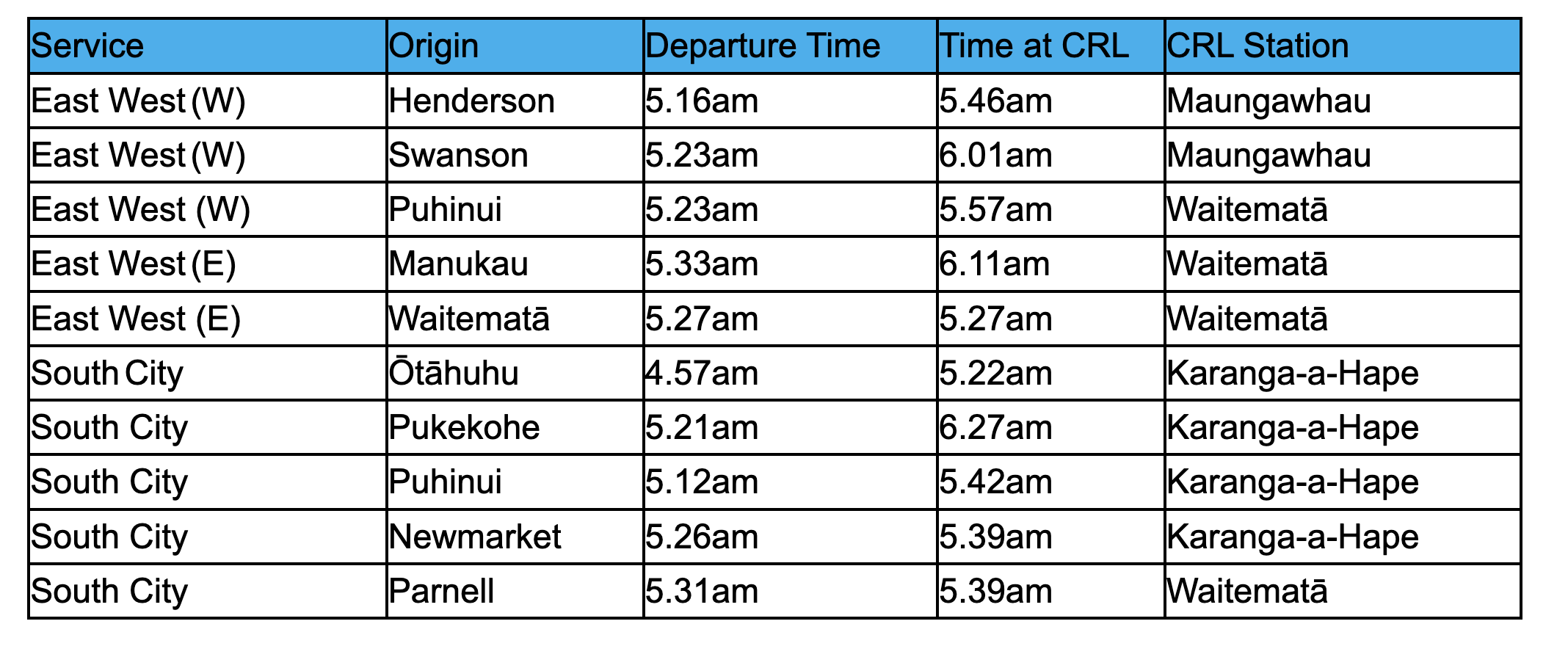
First services on 13 September will be departing earlier than a standard Sunday timetable, from around 5am from across the network.
Trains on the East West line will depart from Henderson, Swanson, Puhinui, Manukau and Waitematā, with first services on the South City from Pukekohe, Puhinui, Parnell and Newmarket (see table below).
This gives lots of options to be on a first passenger service through the CRL departing from across the network.
Demand for trains throughout the day is expected to be high.
“We know many people will be keen to be on one of the first services, and we encourage people to start their first journey from their local station. Trains from right across the network will be travelling through the CRL from early that morning, so there will be plenty of opportunities to be part of this historic day,” says Stacey van der Putten.
The new off-peak timetable means trains will run every 15 minutes all day on weekends. However, for opening on Sunday 13 September, there will be additional services on the East West and South City line above the standard Sunday timetable.
Auckland Transport will also have ambassadors positioned across the rail network to help passengers navigate the new stations and services.
"They'll be on hand to help answer questions, provide directions and make it easier for people to find their way around the new network," says Ms van der Putten.
“We know people are excited to experience the City Rail Link. We ask everyone to be patient and expect trains and stations to be busy as people check out their new network."
KiwiRail and Auckland One Rail will also deploy extra staff during the opening period to ensure train services and track infrastructure run smoothly, and any issues can be responded to rapidly.
Emergency services prepare for City Rail Link opening with final training exercise
24 August 2026
One final multi-agency emergency exercise will take place in the City Rail Link's underground stations and tunnels this week, ahead of the CRL opening to passengers on 13 September.
Fire and Emergency New Zealand, New Zealand Police and Hato Hone St John will work alongside train and station staff to simulate a fire on a train near Te Waihorotiu Station.
While not a formal requirement, the exercise provides another valuable opportunity for emergency responders to work together and strengthen preparedness in the new underground environment.
Hato Hone St John Area Operations Manager, Kim Moser, says these realistic exercises help ensure emergency services are well prepared to respond safely and effectively if they are needed once the CRL opens.
“For Hato Hone St John, this testing has been an important opportunity for our ambulance personnel to build familiarity with the CRL’s new underground environment and practise coordinated responses alongside our emergency service and transport partners.”
The exercise builds on an extensive emergency testing programme completed last month, which involved more than 1,400 volunteer passengers and tested responses to a range of realistic scenarios including train derailments, station fires and mass evacuations.
Auckland Transport (AT) General Manager Rail Services, Mark Lambert, says the programme has provided confidence the City Rail Link is ready to welcome Aucklanders when it opens on 13 September.
“The City Rail Link is unlike anything else in New Zealand's rail network, so it has been vital for everyone involved to practise how we would respond in a range of different situations. The strong collaboration between emergency services and our rail partners has helped build confidence that Aucklanders will be well supported should an incident ever occur.”
The tests were comprehensive and looked at frontline responses through to the supporting systems behind the scenes, including ventilation and smoke extraction, alarms, communications, CCTV, lighting and control room operations.
KiwiRail leads and coordinates emergency response to incidents in the CRL tunnels via its Auckland Rail Operations Centre. Auckland One Rail responds to unplanned events on trains and in the CRL stations – with the assistance of emergency services as needed.
“The City Rail Link’s underground environment, with tunnels more than 40 metres below ground in some parts, presents unique challenges around access, evacuation and communication, requiring specialist planning and coordination,” says Patrick Brockie, City Rail Link Ltd Chief Executive.
“I want to thank every single person who’s played a part in this mammoth effort to ensure Aucklanders can travel with confidence, knowing they'll be well taken care of should the unexpected ever happen in our new stations and tunnels.”
Around 200 personnel and more than 50 emergency service vehicles took part across the programme, working together to test how the system performs when it matters most.
15 live exercises were carried out, ranging from smaller drills through to large-scale scenarios involving more than 300 participants at a time. Scenarios included station fires, train failures in tunnels, derailments, onboard medical incidents and complex evacuations across multiple stations.
Participants were often given little or no advance detail, allowing real-time responses to smoke-filled carriages, simulated injuries, low lighting and crowd movement to be observed and assessed.
Volunteer passengers reflected the diversity of Auckland’s daily commuters including older people, those with health conditions, people with limited English, and those with hearing, visual or mobility needs, ensuring the system works safely for everyone. More than 75 actors were also used to simulate situations that couldn’t otherwise be replicated.
Fire and Emergency New Zealand has continued to carry out site visits and additional training in the weeks leading up to opening.
“People may have seen our fire trucks parked outside the stations at all hours of the day,” says Region Manager Ron Devlin.
“There’s no need for concern, we’re simply giving as many crews as possible the opportunity to familiarise themselves with the new environment. Any of our crews across Tãmaki Makaurau may be called on to respond during an emergency.”
All Aboard: City Rail Link Opens on 13 September
Hon Chris Bishop, Minister of Transport
06 August 2026
Auckland's City Rail Link (CRL) will open to passengers on 13 September, with Transport Minister Chris Bishop and Auckland Mayor Wayne Brown confirming the long-awaited opening date.
"This is one of the most significant transport investments in New Zealand's history, and in just a few weeks Aucklanders will finally be able to use it,” Mr Bishop says.
“The CRL will fundamentally change the way Auckland's rail network operates, with faster journeys, more frequent services, and better connections across the city.
"Reaching this milestone has taken years of work from thousands of people, including engineers, construction crews, mana whenua, KiwiRail, Auckland Transport, City Rail Link Ltd and many others. Thank you to everyone who helped make this day possible."
The 3.45km twin-tunnel underground railway and new stations at Te Waihorotiu, Karanga-a-Hape and Maungawhau will transform Auckland’s rail network by reducing travel times, increasing train frequencies, improving cross-city connections and unlocking new opportunities for growth in the city centre.
“People have been asking me for years, when the CRL was going to open. Now we can give them an answer,” Mayor Brown says.
“The good news for Aucklanders and business owners is today’s announcement provides certainty. They can now plan for when our new rail network will open in a few weeks’ time with quicker journeys and better access to the city and work.
“And, for business owners who’ve struggled while the CRL was under construction, they can reap the rewards of being so close to it and the increased foot traffic.
“CRL is a game changer that will unlock many opportunities for the city. It cost too much and took too long but will be appreciated for generations.
"It will shift Auckland up a gear and, along with transport reform, will get Auckland moving!”
All aboard! What you need to know about City Rail Link opening 13 September
CRL Ltd, Auckland Transport, KiwiRail
06 August 2026
The biggest change to the city's rail network in generations begins operating passenger services next month with the opening of the City Rail Link now confirmed for 13 September.
The 3.45km twin-tunnel underground railway and new stations at Te Waihorotiu, Karanga-a-Hape and Maungawhau will transform Auckland's rail network, reducing travel times, increasing train frequencies, improving cross-city connections and unlocking new opportunities for growth. For the first time, trains will travel through the city centre instead of terminating at Waitematā.
Today's announcement by the Minister of Transport and Mayor of Auckland, comes just under six weeks before opening day, giving Auckland Transport, KiwiRail and Auckland One Rail time to complete the final work to get ready. This will ensure operational staff are ready for new rosters and gives customers time to prepare for the biggest change to Auckland's rail network in more than 20 years.
"The next few weeks are about making sure Auckland is ready. We're introducing a completely new rail network, new bus connections, updating thousands of customer touchpoints and helping people understand the new travel opportunities available to them from day one," says Auckland Transport Chief Executive Stacey van der Putten.
New train services, timetable and stations
Aucklanders can start getting ready now by exploring the new network. Tickets are now available for the ‘First Look events’ taking place throughout August, with Maungawhau Station up first this coming Saturday.
“This is a chance for Aucklanders to look around these stations for the first time and get familiar with how the new network will operate before opening day,” says Stacey van der Putten.
Customers can also start planning future journeys now using Auckland Transport's CRL Preview Journey Planner, available through the AT Mobile app.
Trains to run at Christmas and New Year
Along with the addition of CRL to the rail network, Aucklanders will enjoy significantly fewer rail closures, with no full closures needed, says KiwiRail Chief Metro Officer Bevan Assink.
“Following the intensive upgrades we’ve delivered to prepare for CRL, we are progressing a new maintenance regime that allows us to keep trains running more often.
“For example, trains will be running across the whole network on Christmas Eve, Christmas Day and Boxing Day, allowing people to travel into, out of and around the city at this busy festive period.
“There will be short partial closures on two sections of the network starting after Boxing Day until early January, but the majority will remain open throughout the Summer. In comparison, last Summer we closed the full network for 33 days. Those upgrades we delivered for CRL readiness were invasive and intensive but now we have infrastructure ready to reliably support more trains into the future.”
New bus connections
Alongside the introduction of the new rail network, Auckland Transport is making a range of changes across bus services to improve connections and support more seamless journeys.
We are making sure the wider public transport network is ready to support the City Rail Link, with changes that strengthen links between buses, trains and the communities they serve,” says Stacey van der Putten.
Before the City Rail Link opens, Auckland Transport is encouraging all bus users to check the Journey Planner. Even if you aren’t expecting major changes in your area, some existing bus services will have minor timetable adjustments from 13 August to provide better connections with trains in east, south, west and central Auckland.
In south Auckland and Franklin new and improved bus services have been introduced to better connect local communities with the recently opened Paerātā and Drury stations, making it easier for people to access the rail network and travel across the region.
Preparing for a smooth Day 1
Auckland Transport and its CRL partners are also preparing for strong public interest on the opening weekend, with additional staff and ambassadors across the network to help customers navigate the new stations, services and connections. Details of opening day celebrations and special passenger services will be announced closer to September 13.
Rail services operator Auckland One Rail and rail network owner KiwiRail are also deploying extra resources during the opening period, to ensure train services and track infrastructure run smoothly, and any teething issues can be responded to rapidly.
We’ll have extra maintenance crews and more people working round the clock at our rail operations centre – all ready to go in case there are any issues during the launch period, while everything beds in.” says Assink.
City Rail Link features in Architecture Aotearoa
The architectural vision behind City Rail Link (CRL) is the subject of a feature article and video in the latest issue of Architecture Aotearoa.
Architectural writers Andrea Stevens and John Walsh look at how Aotearoa New Zealand's largest transport infrastructure project is helping reshape Tāmaki Makaurau Auckland.
They highlight the close collaboration between Grimshaw Architects, Jasmax, WSP Architecture, City Rail Link Limited and Mana Whenua in designing stations and civic spaces that reflect the city's cultural identity, history and future.
Drawing on Te Aranga design principles, integrated public art, te reo Māori station names and place-specific narratives, CRL's stations were designed as enduring public spaces built for decades of growth.
Andrea and John’s story explores how transport and architecture can work together as 'city-making' forces. With CRL, that means bringing people within reach of jobs, learning, culture and public life - while shaping the stations, streets, buildings and spaces that give those connections meaning.
Read their full article in the latest edition of Architecture Aotearoa at - https://homeofarchitecture.co.nz/city-rail-link/ and watch the video at https://www.youtube.com/watch?v=RZlclRhB3vo
Take a ‘First Look’ at the City Rail Link stations, and your new public transport journeys
Aucklanders can now explore how much easier it will be to get to more parts of the city with a new Journey Planner tool that shows what journeys will look like when the transformational City Rail Link (CRL) opens. A schedule of free, public ‘First Look’ events at each station has also been confirmed.
The Journey Planner preview launch coincides with the release of the initial CRL opening timetable that will take effect when services begin.
"It will be possible to get a direct train from Panmure to Kingsland to go to Eden Park, from Pukekohe and Papatoetoe direct to a show in the city centre or a restaurant and op-shop on Karangahape Road," says Cr Andy Baker, chair of the Auckland Council Transport and Infrastructure Delivery Committee.
“To help customers prepare for the changes, AT has added a new Journey Planner feature that allows users to switch between today's network and the future CRL-enabled network."
The CRL will fundamentally reshape how trains move through Auckland. Auckland’s train timetable will change completely with three new train lines, East West, South City and Onehunga West, and three new city stations, offering more ways to connect with people and places across Auckland.
At peak, trains will run every five minutes through the city centre and on average around 10 minutes elsewhere on the network. At off peak the new lines will operate every 15 minutes throughout the day, including weekends, compared with every 20 minutes today.
The new Journey Planner tool enables Aucklanders to better understand how the network will operate on day one and let them plan trips with greater confidence.
“We want people to get familiar with the new lines and where the new stations sit. Even a small change, such as your regular train arriving a few minutes earlier or later, can have a big impact on your day and we want to help people plan ahead,” says Mark Lambert, Auckland Transport Group Manager Rail Services.
“If you want to see what travel will look like on a Monday, you can select that option. If you’re looking to see how you can connect with bus services near new train stations, the tool will show you the options.”
The priority when opening the City Rail Link is to provide reliable services, so like other major rail projects overseas, the CRL will open with an initial timetable for the first few months. This means during peak at stations outside of the city centre, services will initially operate at similar frequencies to today, before increasing after more confidence is gained operating the new network.
To use Journey Planner Preview, visit at.govt.nz and navigate to Journey Planner or download the latest version of the AT Mobile app. Full timetables are now available on Auckland Transport's website and more detailed guidance for customers will be shared in the lead up to opening.
First Look Events
Auckland Transport, City Rail Link Limited and KiwiRail are also opening the new stations to the public through a series of 'First Look' events. These will be free, ticketed sessions, but numbers will be limited.
"This will mark the first time the public will be able to enter Auckland's newest stations and we're excited to give people the opportunity to experience them before passenger services begin," says Mark Lambert.
Visitors will be able to walk through the stations, learn about their designs and hear more about how the new rail network will operate when the CRL opens. It will also allow people to rediscover the station neighbourhoods, which now feature upgraded streets and public spaces.
The events will take place over consecutive Saturdays in August:
8 August – First Look at Maungawhau
15 August – First Look at Karanga-a-Hape
22 August – First Look at Te Waihorotiu
Aucklanders can pre-register their interest in these events now using this link. Tickets will be available one week ahead of each event. Those who pre-register will get an email alert as soon as tickets are available to sign up for.
Each station will host ten one-hour sessions from 8am. From low-sensory and early bird sessions to busking and community performances inside, and food, pop up experiences and interactive installations and activities in the station neighbourhoods, guests are encouraged to choose the session that appeals to them most. Ticket holders will need to attend within the session they have registered for.
More information about the events, including how to get there and what attendees can and can't bring, will be provided closer to each event
City Rail Link Stations blessed
Mana whenua involved in the City Rail Link (CRL) project today carried out Mahi Ōkawa (formal blessing) of the new CRL stations.
The eight iwi of the City Rail Link Mana Whenua Forum are Ngāti Whātua Ōrākei, Te Ākitai Waiohua, Te Kawerau ā Maki, Ngāti Maru, Ngāti Pāoa, Ngāi Tai ki Tāmaki, Ngāti Tamaoho, and Ngāti Te Ata Waiohua.
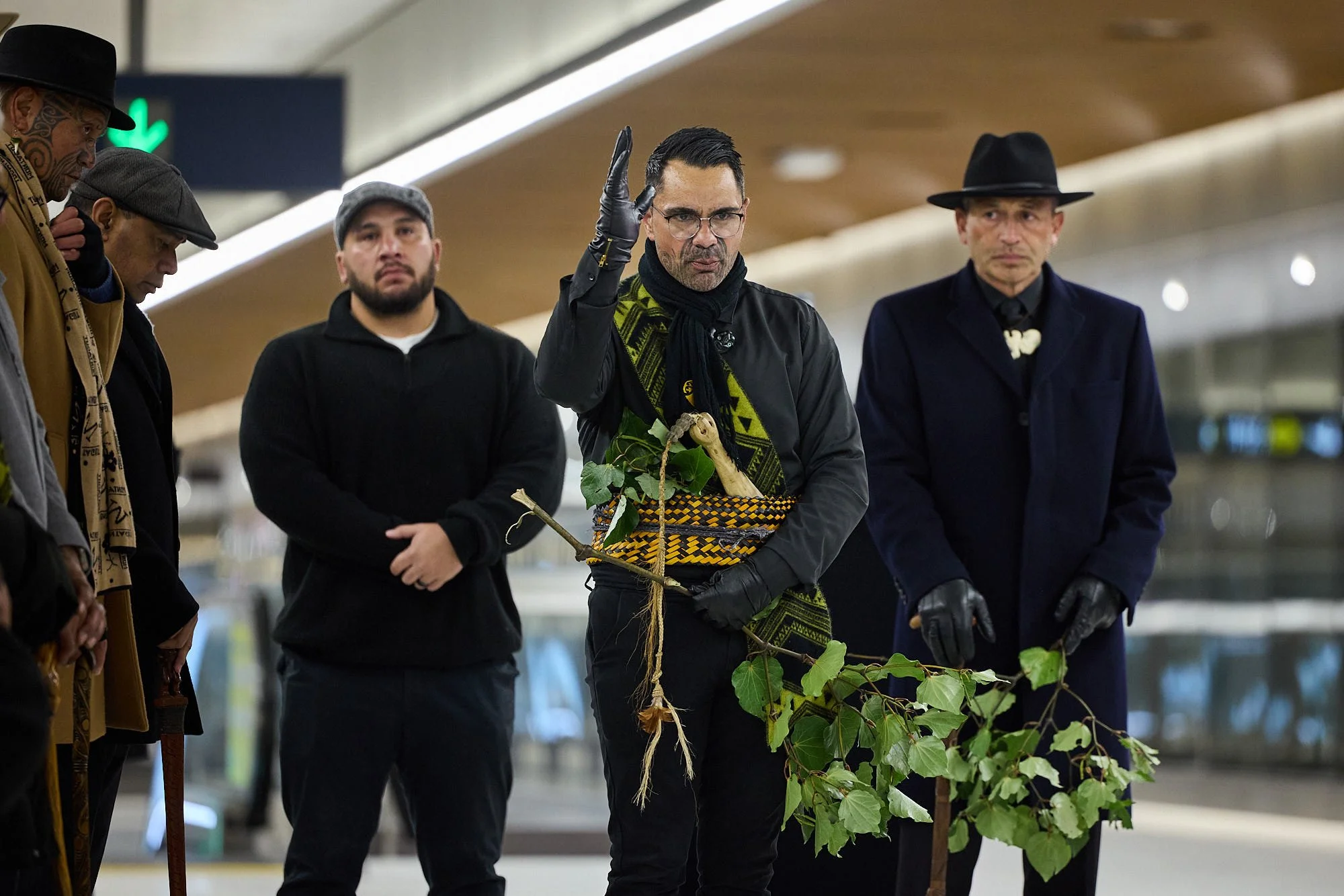
With the project now into the final readiness phase, this morning’s milestone - led by tangata whenua Ngāti Whātua Ōrākei - provided important tikanga and cultural safety ahead of upcoming "First Look" public open day events and the commencement of passenger services.
Ngārimu Blair, Deputy Chair of Ngāti Whātua Ōrākei, says the City Rail Link is an important step in a wider journey to transform not only Auckland’s city centre, but the economy of the entire region.
Our related iwi from across the region were represented in today’s ceremony, which we led to recognise the regional significance and impact of the City Rail Link. By connecting people and communities more efficiently and affordably, the CRL will bring Auckland’s suburbs closer together and deliver positive economic and environmental benefits for generations to come.”
The milestone reflects the ongoing partnership, collaboration and collective effort between mana whenua and the City Rail Link project partners - which started more than a decade ago. It also provided an opportunity to reflect on the journey that has brought Aotearoa New Zealand's largest transport infrastructure project to this significant moment, and to honour the whenua, people and partnerships which have guided the project.
New Drury and Paerātā Railway Stations to open on Sunday 2 August
Auckland’s newest railway stations, Drury and Paerātā, will open to customers on Sunday 2 August 2026, puttingSouth Auckland and Franklin’s fast-growing communities on the rapid transit map just in time for City Rail Link.
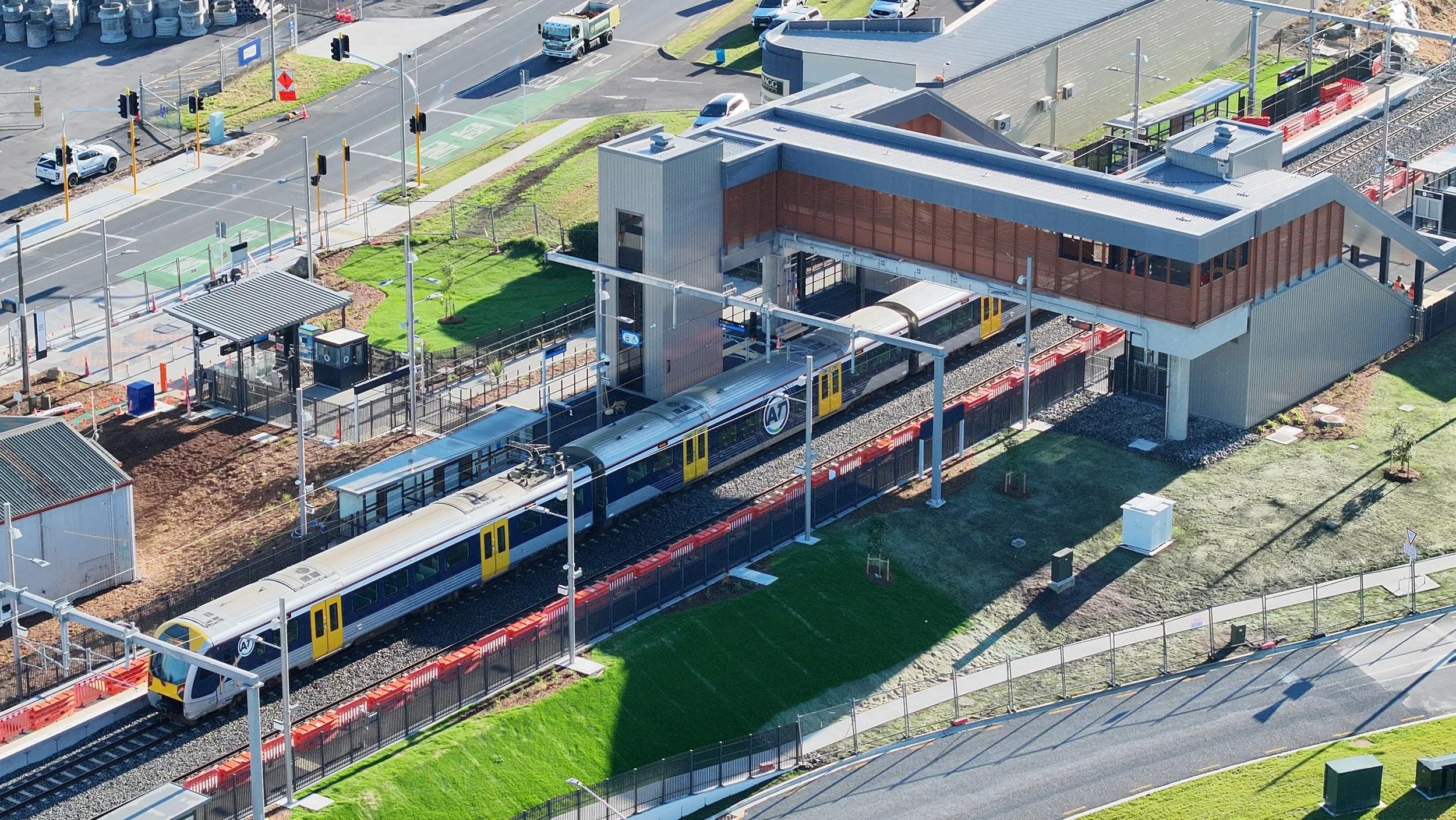
The new Drury and Paerātā stations, which have been built by KiwiRail with government funding, will be served by Auckland’s Southern Line, giving nearby communities seamless public transport journeys to Auckland’s city centre, Auckland Airport (via Puhinui and the AirportLink), Middlemore Hospital and destinations along the rest of the Southern Line.
The opening of the two stations will also be supported by an upgraded local bus network, making it quicker and easier for people in Paerata Rise, Ramarama, Drury, Waiuku, Glenbrook and Pukekohe to connect to Drury and Franklin train stations. Each station also provides 350 park and ride spaces with room for further extension in the future.
The new stations and improved bus services are being welcomed by Councillor Andy Baker, the Transport and Infrastructure Delivery Committee Chair and Franklin Ward Councillor, who is looking forward to Drury Station opening as a Drury resident and regular train commuter.
“It’s been more than 50 years since there was a train station in Drury and since then we’ve seen a huge transformation on Auckland’s rail network, as well as in our communities,” Councillor Baker says.
“These new stations are going to make such a big difference for people living in South Auckland and Franklin and save them countless hours stuck on the Southern Motorway.
“For people who live in or move to subdivisions near the new stations they will have great modern public transport options from day one.
“These stations and buses help make sure the massive growth we’re seeing in Franklin is being supported by the infrastructure communities need, and it will be really exciting to see our communities making the most of these in a couple of weeks.
“Plus, when the City Rail Link opens these new stations will be the starting point for even more trips that at the moment are trickier on public transport, like heading to a test match at Eden Park or to Te Waihorotiu for a night out in town.”
As a local resident who regularly travels by train, KiwiRail’s Chief Metro Officer Bevan Assink, is looking forward to the new stations opening.
“KiwiRail is proud to be delivering the necessary infrastructure required to support train travel today and to future proof for population growth in south Auckland,” Mr Assink says.
“These new stations will provide the wider community with faster routes into the city, more environmentally friendly public transport options, and reduce congestion on roads.”
Bus services designed to integrate new stations seamlessly in wider network
Auckland Transport Chief Executive Stacey van der Putten says the new stations are part of a much bigger transformation of Auckland’s public transport network.
“From Sunday 2 August, Drury and Paerātā Railway Stations will be connected directly into Auckland’s rail network, with trains running from early morning until late evening, seven days a week,” Ms van der Putten says.
“Over the past few years there has been a massive investment in improved public transport links for South Auckland and Franklin, with the electrification of the Southern Line to Pukekohe and big improvements to bus services that line up with train timetables.
“Auckland Transport has worked closely with KiwiRail during the design and construction of these stations, which include lots of useful features for passengers like Park and Ride facilities, pick-up and drop-off areas, and parks for both bikes and motorbikes.
“With the opening of these two new stations we are giving people real transport choices at a time when we know Aucklanders are looking further out of the city for more affordable housing and a lifestyle that suits them.”
City Rail Link emergency testing underway
8 May 2026
Smoke machines and volunteers acting as injured passengers will help to simulate fires and other emergencies as part of large-scale safety testing to ready City Rail Link for opening.
The emergency evacuation tests on trains, in the new tunnels and the new stations are among the most critical steps before City Rail Link can open to the public later this year. They’re designed to make sure systems are safe, reliable, and ready for customers and that everyone involved knows exactly what to do in an emergency.
“Having to evacuate into an underground rail tunnel is a confronting prospect for many people”, says Auckland Transport Interim CEO Stacey van der Putten.
“But planning for unlikely events is essential. Train crew and station staff need to be prepared and ready to work alongside emergency services to help customers safely evacuate to street level if an incident were to occur in the City Rail Link.”
The tests simulate a range of emergency and real-life scenarios such as fires, incidents onboard trains, unruly passengers, or tunnel evacuations. Rail operators will be working closely with Fire and Emergency New Zealand, NZ Police, and Hato Hone St John.
“These exercises give us a vital chance to put our plans, procedures, and specialist training for this unique underground environment into practice,” says Fire and Emergency NZ Assistant District Commander, Dave Woon.
“Desktop exercises helped us identify the theoretical challenges,now we can test them for real. It’s a chance to check our systems, equipment, and communication under pressure, and to make sure all agencies are aligned and ready to respond confidently and effectively.”
The City Rail Link will become part of Auckland’s wider rail network, so these tests are also vital to ensuring teams from KiwiRail and rail operator Auckland One Rail can coordinate effectively to keep services running smoothly across stations, tunnels, and trains. Most testing will be focused around Te Waihorotiu, Karanga‑a‑Hape and Maungawhau stations, with some activity around nearby Waitematā Station. “It’s worth remembering that Karanga-a-Hape Station is 33m below ground – roughly the height of a 10-story building, and that creates real challenges in an emergency” says City Rail Link CEO, Pat Brockie.
“These exercises also allow us to confirm that all systems and technology are working as they should, from fire alarms and ventilation systems to the technology that opens emergency doors and overrides lifts. We’ll also see how real people respond and react. If we need to make changes to procedures in response to what we learn through these tests, we can do so now ahead of opening”.
Emergency testing began in late April and will run through until early June. There are 15 scenarios varying in size from small exercises with a handful of volunteers, up to four major tests with more than 300 volunteer passengers, selected to reflect the diversity of Auckland’s everyday commuters.
“We want to test how the system works for the whole community, so that means everyone from parents with prams, to older people, people with accessibility considerations or mobility needs and people with English as a second language,” says Stacey van der Putten.
The volunteers have been recruited from within organisations involved in building and opening CRL. They may find themselves in situations with smoke, low lighting, increased airflow and walking through tunnels and up stairs.
Local residents and passers-by may see several emergency vehicles and personnel outside stations. Contingency plans are in place should an actual emergency happen during testing.
The emergency tests are part of a wider programme of checks and balances to test every aspect of the new infrastructure and the passenger service that will operate within it. You can find out more here about what it takes to open the City Rail Link.
Mind the Gap: April rail closures explained
30 March 2026 (AT)
Critical upgrade and testing work to enable the City Rail Link (CRL) to open as soon as possible, will be carried out while Auckland’s rail network is closed at Easter Weekend and a number of days during the school holidays.
To help deal with extra demand, Auckland Transport has arranged more than 100 replacement bus services to keep Aucklanders moving during these rail closures, including express options for Western and Southern line passengers. That’s nearly a 60% increase on what AT was able to secure during January’s closures.
Auckland Transport Director of Public Transport and Active Modes, Stacey van der Putten says the work and testing during rail closures are needed now to stay on track to open City Rail Link in the second half of this year.
“We know more people are turning to public transport as fuel prices rise. These works are on the critical path and delaying them now would result in delays completing City Rail Link work and ultimately opening the new services to Aucklanders,” Ms van der Putten says.
“Providing a full range of bus alternatives and doing the work during school holidays when we impact fewer people is the best way we can deliver without delay while minimising the disruption to passengers.”
The closures will see KiwiRail and Auckland Transport work on a range of upgrades to allow City Rail Link to open with a better and more reliable Auckland rail network. They include works at Henderson station, three new station bridges to replace level crossings, train signalling improvements, track renewals and replacements, infrastructure upgrades, work on three new Drury stations and three days testing the new Auckland-wide City Rail Link timetable.
When the City Rail Link opens in the second half of the year, Auckland’s train network will change significantly. A new timetable will introduce three new train lines, East West, South City and Onehunga West, along with three new city stations, creating more frequent, better connections across the region.
What is happening during CRL testing?
To introduce this reliably network-wide testing will take place 13-15 April.
“Our priority when opening City Rail Link is to provide reliable services. So, consistent with international practise and lessons learned from overseas rail projects, we're planning a staged approach to introducing higher frequencies for the new services,” says van der Putten.
“We will open City Rail Link with a temporary transitional timetable to help customers and our staff get used to the changes. We will test both this temporary timetable and the higher frequency peak train services that we plan to ramp up to within about six months.”
“April’s testing will help us confirm what the temporary transitional timetable will look like and how long it is likely to be in place for.”
Testing covers everything from train positioning, scheduling, and rostering to real time passenger information on trains, at stations and on our mobile apps. Coordinating trains across 45 stations to a brand-new timetable, with accuracy measured in seconds, is a really complex task.
Dry runs allow rail controllers, drivers and operators to practise managing a much busier network with new train lines and more passenger, freight and inter-regional trains sharing the same tracks.
Bus services to replace trains
We know buses and trains are busier than usual, so a full complement of replacement bus services will be available to keep people moving during all rail closures, including express options for Western and Southern line passengers.
We will also have buses on standby ready to be deployed where more capacity is needed when scheduled rail buses get full.
People can also use local regularly scheduled bus services which run at least every 15 minutes 7am till 7pm.
The majority of the rail replacement buses will be fitted with GPS tracking, allowing customers to see when the next bus will be arriving at the rail station via the AT mobile App.
We encourage people to use the AT Journey Planner ahead of travel to check out the rail bus timetable.
The full rail network will be closed for passenger services on the following dates:
April 3 - 6 (Easter Weekend)
April 13 – 15 (Weekday closures for CRL timetable testing)
April 25 – 27 (ANZAC Day weekend closure – trains will run until 2pm on Saturday 25 April to allow people to attend memorial services, following this there will be a full rail network closure until Tuesday 28 April 2026.)
There will also be a number of partial and full line closures throughout the school holidays. The schedule can be found here.
Safety during CRL testing
A reminder that even though passenger trains will be unavailable, trains will still be travelling across the train network and through road and pedestrian level crossings.
For your safety, always stop to check both ways for trains before crossing the tracks. Stay alert to stay safe.
April Rail closures
24 March 2026
https://at.govt.nz/bus-train-ferry/service-announcements/april-rail-closures
New look neighbourhood – improvements to area around Karanga-a-Hape Station now complete
25 February 2026
The area around the new Karanga-a-Hape Station has been reshaped to make it easier, safer and more welcoming for people moving through the area, completing another important step towards opening the City Rail Link (CRL) later this year.
Karanga-a-Hape Station will play a key role in Auckland’s wider public transport network served by both the East West Line and the South City Line on the new rapid transit network. This means whether you’re coming from Pukekohe, Papatoetoe, Glen Innes or Glen Eden - K’ Road is an easy train ride away with trains running every few minutes at peak times.
Earlier today, representatives from Ngāti Whātua Ōrākei, Te Ākitai Waiohua, and Ngāti Te Ata Waiohua led a blessing in Mercury Lane, on behalf of mana whenua. This formally marked the completion of the Karanga-a-Hape Precinct Integration Project.
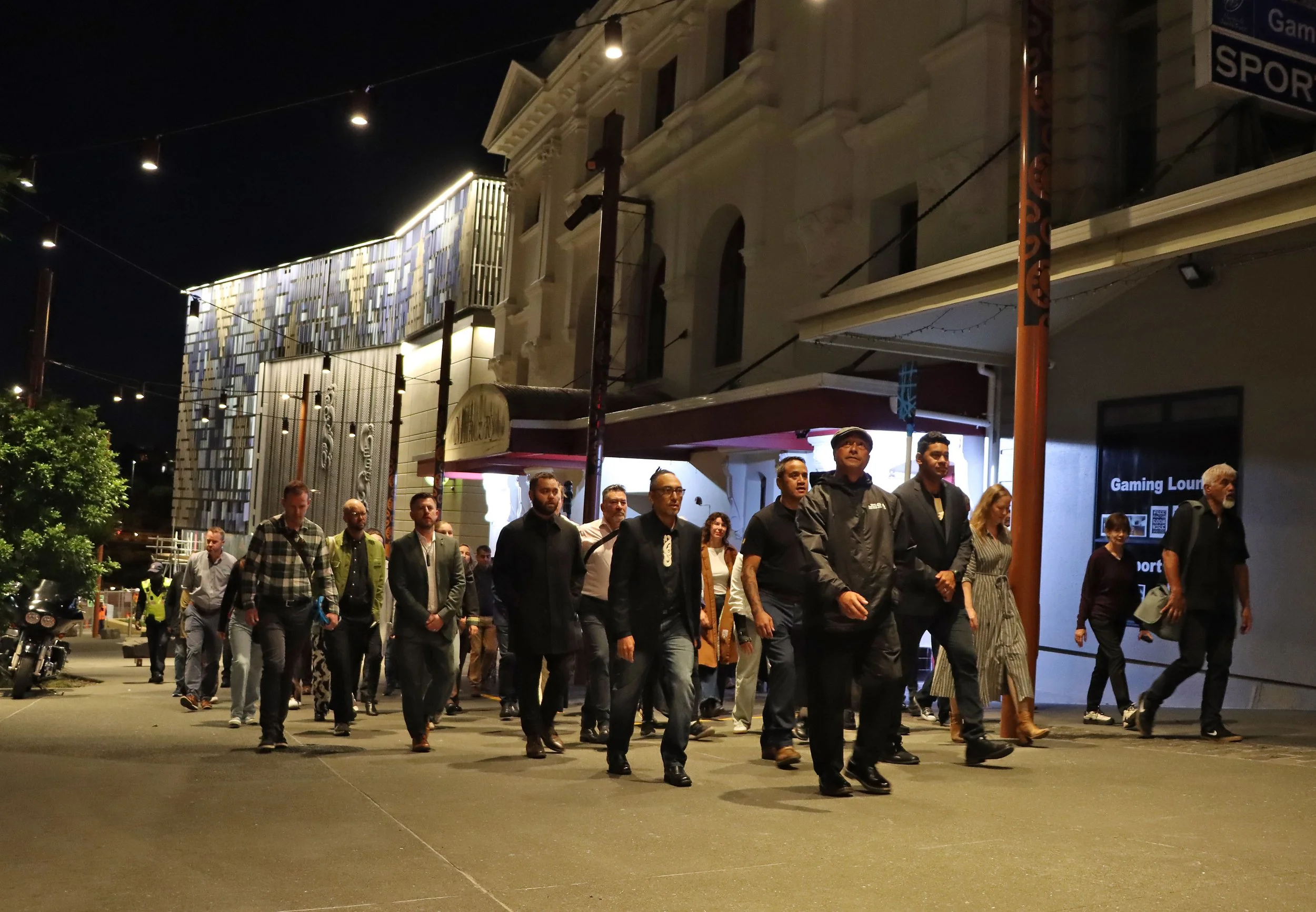
The Auckland Transport-led project was supported by Auckland Council and NZ Transport Agency Waka Kotahi and includes better, brighter public spaces and upgrades to Pitt Street, Beresford Square, Mercury Lane, Cross Street, Canada Street and East Street.
We know when the City Rail Link opens this year there’ll be a lot more people travelling from across Auckland to the city centre, with the area becoming a transport hub. At Karanga-a-Hape, our brand-new train station will intersect with some of the city’s most popular bus routes, including the WX1 and future Northwest Busway services,” says Jane Small, Auckland Transport Co-Director of Infrastructure and Place.
“The improvements will make connecting to transport services easier for those who visit or live and work in the area, as well as opening up new public spaces leading to local restaurants and shops.”
Relocated bus stops, road resurfacing, new pedestrian crossings and wider footpaths have created a more functional and user-friendly area. Garden beds and native tree plantings add bursts of green through the area.
Cyclists can navigate more safely through the busy streets by using new separated lanes on Canada St, East St, Pitt St and Vincent St which link up with existing cycle routes such as Te Ara I Whiti – The Lightpath.
“The City Rail Link is not just about journeys, but destinations. With Karangahape Road more accessible than ever before, there are opportunities for more homes, businesses, arts and culture above ground too. The outstanding artistic elements of the stations and new public areas raise the dignity and mana of the space and all of us”, says Alex Bonham, Chair of the Waitematā Local Board.
Artwork designed by mana whenua adds to the vibrancy Karangahape Road is already well-known for, transforming Mercury Lane with features that reflect the history of the area. New light poles are inspired by Tāne Mahuta (God of the Forests), complementing the new CRL Karanga-a-Hape Station designs.
The poles are ochre in colour, representing the separation of Tāne Mahuta’s parents Ranginui (Sky Father) and Papatūānuku (Earth Mother), while the black kaperua patterns reference the enduring strength, protection, and guidance Tāne provides. Festoon lighting and star motif projections on the ground mark Te Whānau Marama, the light-giving family – the sun, moon, and stars that Tāne placed in the sky.
“The collection of cultural designs acknowledges the stories of the past, reflects the present, and lights the way for the future. Together, they pay tribute to the people of Karanga-a-Hape, will welcome station users, and connect the wider community to a place of belonging, care, and shared life,” says lead mana whenua artist for the precinct project Pāora Puru (Ngāti Te Ata Waiohua).
The Karanga-a-Hape neighbourhood is the second CRL station area to be completed in recent weeks, following the reopening of the Waitematā Station Plaza at the end of January. Auckland Transport acknowledges that this type of work impacts businesses and people who live in the area and would like to thank locals for their open communication, input and patience while the improvements were made. “It’s great to see the public gain access to these new sites as we get closer to the opening of the City Rail Link. We are excited about the opportunities it brings to our businesses who will welcome more foot traffic in the area,” says Jamey Holloway, General Manager K’ Road Business Association.
Karanga-a-Hape Station has entrances at both Mercury Lane and Beresford Square.
All Trained Up – Rail Fleet Expansion And CRL Driver Training Complete
05 February 2026 (AT)
Auckland’s newest electric train has rolled into port, marking the arrival of the 23rd and final unit in Auckland Transport’s (AT) fleet expansion.
The delivery brings the total fleet to 95, helping enable more frequent and reliable services after City Rail Link (CRL) opens later this year.
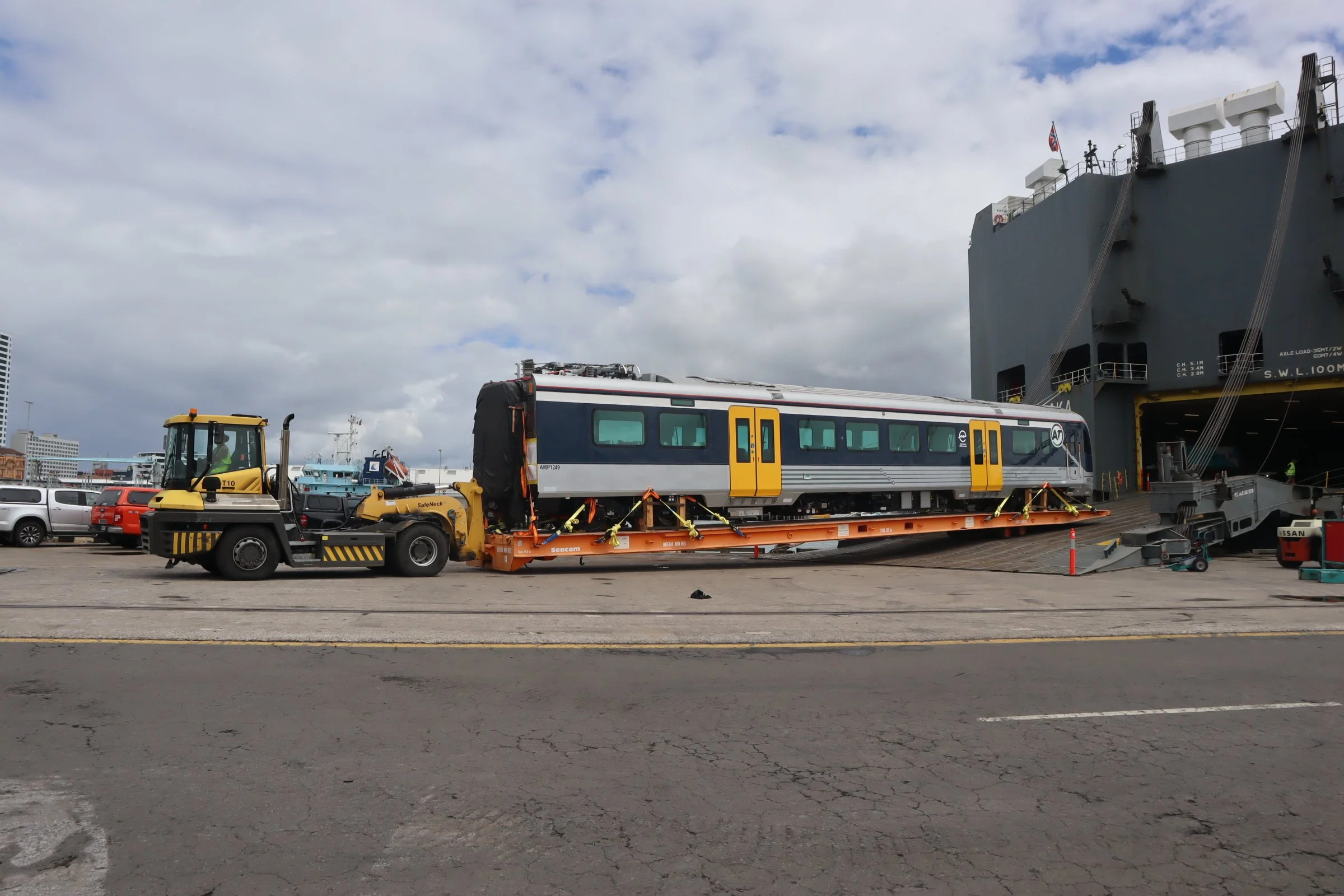
Built by Spanish train manufacturer, CAF, at its manufacturing facility in Mexico, the new trains have each travelled by ship to Auckland before being transported by road to the Wiri Train Depot for inspection, coupling, testing, and commissioning ahead of entering service.
Reaching the final delivery is a significant achievement as we get ready to open the CRL. The project isn’t just about tunnels and stations — it increases the capacity of our rail network so we can provide trains more often, increasing over time” says Stacey van der Putten, Auckland Transport Director of Public Transport and Active Modes.
They arrive as individual carriages, which are assembled into threecar trains. Trains can operate across the Auckland network as three-car sets or be coupled in pairs to run as sixcar trains depending on demand.
The $330m investment has been jointly funded by the government with NZ Transport Agency Waka Kotahi (NZTA) covering half the cost and Auckland Council meeting the balance.
Included in the funding was extended stabling facilities at the Wiri Depot – delivered as a separate contract - and the modification of the existing fleet of 72 trains to ensure they are compatible with the CRL, work which has now been completed.
“We’ve retrofitted trains with improved features such as operational connectivity, LED lighting, drag-detecting door sensors, and emergency alarms,” Ms van der Putten says.
Auckland Transport owns the fleet, sets service patterns, and provides customer information systems, while operator Auckland One Rail (AOR) maintains and runs the services.
The majority of the new units are already operating across the network and were heavily used in AT’s region-wide timetable simulation held at the end of January.
The exercise saw 84 trains running across the network to test CRL ready frequencies and ensure safe, reliable performance ahead of the CRL’s opening in the second half of 2026.
“The testing was a valuable learning curve”, Ms van der Putten says.
“It highlighted several challenges, particularly around network congestion, which our teams are now working through. We’ll tweak a few things before we run the simulation again in the April school holidays, to help us finalise a robust timetable and provide reliable services from day one.”
The testing has also given AOR critical insights into how its train crews, station teams, and operations staff will manage the uplift in services.
AOR has now completed a major training programme to prepare its drivers for driving through the new stations and tunnel environments.
264 drivers are certified to operate the new CRL routes and 195 train managers have completed station familiarisation.
There’s still lots more to do before opening with a further 101 customer service staff currently in training through-out the new stations.
Our CRL checklist shows how we are progressing through the testing and commissioning phase.
Before opening the CRL, project teams will be completing important work to be ready, including:
· Thoroughly testing the stations, including emergency and technology systems
· Testing train operations in the tunnel, and across a new network-wide timetable
· Ensuring all parts of the public transport system are ready for launch
· Completing planned rail network upgrade projects
· Finalising the regulatory approvals needed for the CRL and new services
First City Rail Link station neighbourhood complete
29 January 2026
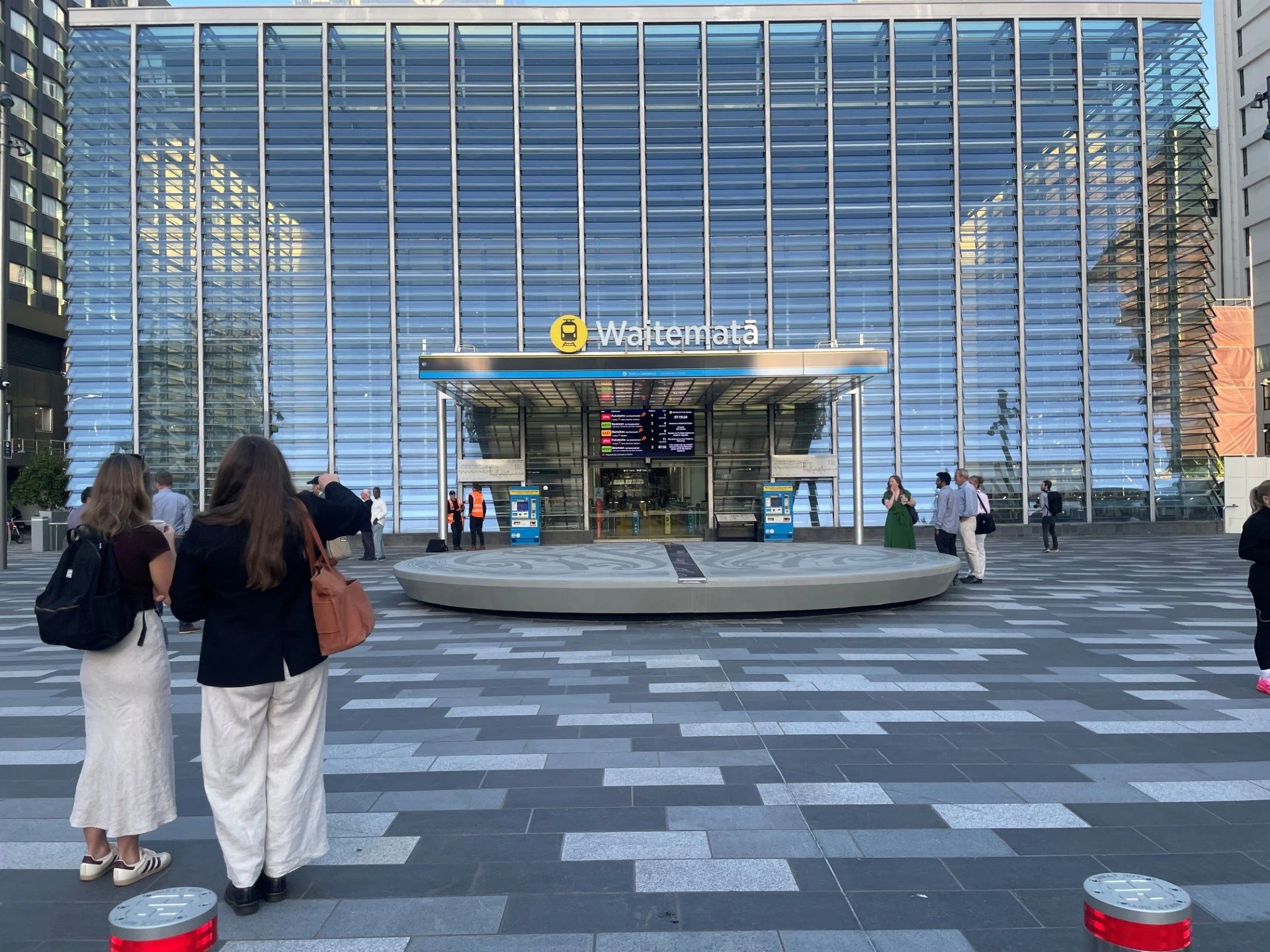
The Waitematā Station Plaza and eastern glasshouse entrance to the station are open for the public from today (Thursday 29 January), completing the City Rail Link’s first station neighbourhood in the city centre.
This is the first of three above ground renewal programmes being delivered around CRL stations by the Auckland Council group and City Rail Link Limited in the city centre.
The Waitematā Station neighbourhood marks its completion today; Karanga-a-Hape Station precinct will finish next month; and Te Waihorotiu Station precinct will finish later in the year.
Chair of the Policy, Planning and Development Committee, Councillor Richard Hills, is excited to see another public space open to Aucklanders and visitors to our city.
“After the recent refresh of the eastern glasshouse entrance, it’s fantastic that we have now met another important milestone – the completion and opening of the works above ground in this station neighbourhood.”
“This area is functional and stunning, in equal proportion. I’m proud to see it finished, ahead of the historic moment later in the year when CRL is up and running,” he says.
Simon Oddie, Auckland Council Priority Location Director – City Centre, says station neighbourhoods are critical to unlocking the full value of the City Rail Link.
“The City Rail Link is much more than a transport project - it’s a city-shaping investment. Station neighbourhoods are where its benefits are truly realised - places that connect people seamlessly to jobs, learning, culture and daily life, while supporting a more walkable, resilient and low-carbon city centre.”
“Over the past decade, we’ve delivered a coordinated programme of upgrades to prepare the city centre for thousands more people arriving by train, bus, ferry, foot and bike. CRL accelerates that shift, and these station environments are the physical expression of a more connected, people-focused Auckland.”
“By designing the stations and their surrounding streets together, we’re creating places that work harder for Auckland - places that support economic activity, encourage public transport use, and make the city centre easier and more enjoyable to get to and move around.
Referencing the thinking of American urban economist Edward Glaeser, Oddie says the approach reflects the role cities play at a global scale.
“As Edward Glaeser says, ‘Cities are humanity’s greatest invention.’ To unlock that potential, cities need to be well planned and operate efficiently. These station neighbourhoods are about doing exactly that - using major transport investment to shape better urban outcomes above ground, not just below it,” he says.
Simon Oddie adds that the Waitematā Station neighbourhood has become a highly efficient transport hub.
“It’s a greener and more attractive place to spend time in now. We have trees for shade and other environmental benefits, better lighting, public art, and spaces that reflect the identity of Tāmaki Makaurau. Our partnerships with mana whenua are central to this work. These environments tell a story about place, culture and connection, and we’re proud of what that represents for Auckland’s future,” he says.
The Auckland Council group has worked for more than ten years alongside City Rail Link Limited, Auckland Transport and the private sector to ensure the stations’ surrounding streets and spaces are enhanced and ready for the influx of people expected to arrive when CRL opens later in 2026.
Walk the City Rail Link’s first finished station neighbourhood, with a ten-stop walking tour on OurAuckland.
Some of the projects completed around Waitematā Station:
Albert Street bus interchange
Quay Street
Te Wānanga - waterfront plaza
Sea wall
Te Ngau o Horotiu – six new ferry piers
Te Komititanga – downtown square
Restored CPO
Galway Street + Tyler Street - shared spaces
Skylid + Waitematā Station Plaza
CRL benefits Auckland-wide:
Benefits for the city centre, the biggest employment centre in Auckland, have been well articulated. But many other town centres will also be better-connected.
Auckland Council’s investment in this major infrastructure project will deliver a significant return on the council’s 50% stake in the project, across the region. Read more here.
A better-connected Auckland will in turn support a more liveable, productive, modern city, attracting top talent to live and work here. Read more here.
Auckland Transport’s bus system is well placed to play a key role in an efficient integrated transit network with over 100 bus routes updated or optimised to better connect with trains and CRL.
By turning a terminus station – Waitematā Station - into a through station, train frequencies into the city centre will increase immediately from 18 trains per hour to 32. This means one train every 3 – 4 minutes in CRL stations.
Upgrades across the wider rail network are in their final stages to support faster, more frequent and more reliable connections across Tāmaki Makaurau when CRL opens.
The CRL will not only reduce travel times but also double the number of people living within a 30-minute train ride to Auckland's city centre. Read more here.
City Rail Link Region-wide Timetable Testing
27 January 2026
A reminder that City Rail Link (CRL) timetable testing will continue for the rest of today and all day tomorrow.
People will see trains running as part of the testing, but there are no services available to passengers until Thursday morning.
Rail replacement buses are running on a 10-minute frequency during peak times. We are aware there were some delays for passengers boarding buses this morning, and we expect them to be very busy during this evening and again at peak times tomorrow.
Auckland Transport is encouraging people to use regular bus services or travel outside peak hours to help ease the pressure.
Customer Service teams wearing pink vests can help to get you where you’re going or use our AT Journey Planner tool to help find a bus route near you.
The timetable testing is an important milestone on the journey to opening the CRL later this year. A huge amount of planning alongside KiwiRail, City Rail Link limited and our rail operator Auckland One Rail has gone into the testing.
Over the course of the day, more than 280 train drivers and train managers will be out on the network as we put the new timetable through its paces.
Stacey Van Der Putten, Auckland Transport Director of Public Transport and Active Modes says the testing is going well.
“As you would expect when you go from modelling to real-life testing, there are a few issues which are popping up, some we anticipated and some we didn’t such as small delays in getting 84 trains out of the depot and running across the network at once.
So there are a few things to iron out, but nothing that has given us any major cause for concern at the moment.
We are doing the testing, so we can find and fix issues now, before the CRL opens and we switch to a new network later this year. We’ll be running trains more often, on new routes that connect through the city centre, and we want these services to be reliable from Day 1. It’s also a great opportunity for train crews to get more familiar with how the network will change.”
We would like to thank the public for their patience and support. We are building a world-class train network and it’s important we test and test again so we can deliver safe and reliable journeys right from the very first day.
On Track for 2026: CRL testing, summer rail services and what’s next
CRL Ltd, AT, KiwiRail joint release
09 December 2025
This summer we are delivering the last big push on the Rail Network Rebuild and other critical City Rail Link (CRL) preparations, with more than 1,300 people involved in repairing tracks, building new platforms, pedestrian bridges, removing level crossings and testing the new more frequent timetable that will launch when CRL opens next year.
This means closure of the Auckland rail network from 27 December to 28 January 2026, to enable crew to work efficiently and safely. The network will be fully closed for most of this time, with the exception of some Southern/Eastern and Onehunga Line services returning between 19 and 26 January.
“This work is essential to getting City Rail Link up and running, without it we simply won’t be able to run more trains, more often,” says Auckland Transport Director of Public Transport and Active Modes, Stacey van der Putten.
“Balancing delivery with minimising disruption to passengers and freight is tricky to get right. Using holiday periods, when demand is lower, means we impact fewer people, but for those staying in Auckland or working right through, we understand this is frustrating. Please stick with us, better journeys are around the corner,” says van der Putten.
When trains aren’t running, invasive work can be completed much more quickly and safely. This is needed in key areas so the network can support additional trains City Rail Link will enable.
Work completed on sections of the Southern, Eastern and Western lines has already improved reliability and speeds. Over summer, the Rail Network Rebuild programme outlined by KiwiRail a year ago will be completed, with work across at least 40 different sites.
“At Henderson Station, we are rebuilding aging foundations, installing modern drainage and renewing old assets that slow down trains. We’re building a third platform and new track at Henderson to allow space for trains to pick up and drop off passengers and change direction back into the city, making sure we get the most out of CRL into the future as services are increased,” says KiwiRail Chief Metro & Capital Programme Officer, David Gordon.
“Over the last year we’ve made huge progress on the five-year Rail Network Rebuild. Over this time, we’ve replaced more than 80 kms of rail, added 70 kms of drainage and 30kms of foundations. We’ve delivered upgrades and renewals across the whole network to make it more resilient. This sets us up to support more frequent services post-CRL and in the decades to come,” says Gordon.
Network Closures
There will be a month of rail network closures from 27 December to 28 January.
Limited train services will resume on parts of the Southern/Eastern and Onehunga Line during 19-26 January, before all lines and stations are closed again for two days after Auckland Anniversary holiday weekend, for network wide CRL timetable testing.
This is the first round of trialling the new train timetable in full to ensure it is safe, reliable and seamless from the first day CRL is open.
During these tests, trains will operate throughout Auckland but will not be able to carry passengers, as they’ll be travelling through the tunnels under strict testing rules.
To keep people moving there will be buses to replace trains, including express rail buses on the Southern Line. These are in addition to Auckland Transport’s regular bus services which train users can use to get around the city.
Ensuring we are ready to go (Please see attached graphic)
Before opening City Rail Link, project teams will be completing important work to be ready, including:
Thoroughly testing the stations, including emergency and technology systems
Testing train operations in the tunnel, and across a new network-wide timetable
Ensuring all parts of the public transport system are ready for launch
Completing planned rail network upgrade projects
Finalising the regulatory approvals needed for the CRL and new services
Being ready to open involves an integrated programme of work across City Rail Link Ltd, Auckland Transport and KiwiRail. With the work we have to go, we now know we will open CRL in the second half of 2026.
Every part of the station buildings, and each piece of technology in them needs to work as planned individually and work together as a system. This is crucial both to the everyday passenger experience, and to safety in the event of emergencies.
“System tests are progressing well, and next year will advance to include live trials with emergency services and mock ‘passengers’ inside the stations,” says City Rail Link Limited CEO Pat Brockie.
Train testing is moving from tests inside the tunnels to tests on the wider network. These require us to close the network to the public in January and again in April as we test our whole new timetable.
“This is New Zealand’s first underground railway and a major change for Auckland’s train network. Only through testing can we find and fix any issues before opening day. We have drawn on international experience from similar projects and planned a thorough programme of tests to make sure the network is safe and reliable from day one,” says Stacey van der Putten.
Still to come
Further closures are planned in the lead-up to City Rail Link opening, for rail infrastructure work, and for further tests and trials. These will be limited to weekends and public holidays as much as possible, however we are asking Aucklanders to be prepared for longer closures in the April School Holidays.
After City Rail Link opens, closures will be much less frequent – but some will still be needed. Further investment has been announced to deliver a programme of level crossing projects, including new bridges, and this work will sometimes mean lines have to be closed, alongside the usual maintenance associated with busy metro networks.
Closure details:
27 December – 18 January: Full rail network closure.
Buses replace trains while we upgrade your train network.
19 – 26 January 2026: Partial rail network closure.
Trains only running between Newmarket to Manukau on the Southern Line & on the Onehunga Line.
No trains running on the Western Line and Eastern Line between Waitemata to Otahuhu.
27 – 28 January: Full network closure for City Rail Link testing.
We're testing your future train network, so we're ready for more trains, more often when City Rail Link opens.
Trains will be operating as part of the test but will not take passengers.
All stations will be closed.
People can plan their trip using the AT Journey Planner which will let them know what public transport options are available.
Find out more Summer Rail Upgrades
Closures later in 2026 – subject to change
To complete further level crossing replacements, CRL testing and signalling upgrades, we will also need to close or partially close the network as outlined below. Exact details of closures (e.g. timing) and alternative transport options are confirmed ~3 months in advance and are often dependent on what happens during other works.
Please note that plans can also be affected by weather or other incidents on the network so may be subject to change.
6 – 8 February (Waitangi Day long weekend)
No trains running on all lines.
28 February – 1 March
No trains running on the Eastern and Southern Lines. Western Line closed between New Lynn and Swanson.
14 – 15 March
Southern Line closed south of Puhinui.
Eastern Line closed between Ōtāhuhu and Waitematā (Manukau to Ōtāhuhu served by Southern Line trains).
22 March
Full network closure for CRL timetable testing
3 – 6 April (Easter long weekend)
No trains running on all lines.
7 – 12 April (School Holidays)
Southern Line closed south of Puhinui.
Eastern Line closed between Ōtāhuhu and Waitematā (Manukau to Ōtāhuhu served by Southern Line trains).
13-15 April
Full network closure for CRL timetable testing
25 – 26 April (Anzac Day)
Trains will run in the morning on Anzac Day (25 April) until 2pm. From 2pm on 25 April and all day on 26 April, no trains running on all lines
Light at the end of the tunnel for CRL construction
Offices of Hon Chris Bishop and Hon Simeon Brown
28 November 2025
The upgraded Auckland public transport network with City Rail Link (CRL) at its heart will open to passengers in the second half of 2026.
Transport Minister Chris Bishop, Auckland Minister Simeon Brown, Auckland Mayor Wayne Brown and Auckland Deputy Mayor Desley Simpson confirmed the project is on track to open in 2026, but that significant important work still needs to happen to ensure a safe, reliable service at opening.
“The finish line for the City Rail Link is getting closer,” Minister Bishop says.
“CRL is a massive multi-billion-dollar investment for the Government and Auckland Council. New Zealand can look forward to the benefits this project will deliver next year.
“World-class new stations have taken shape, while streets and public spaces affected by construction are now reopening to Aucklanders. Work is moving from construction to systems testing and commissioning.
“Aucklanders continue to show patience and understanding as this massive construction project begins to see light at the end of the tunnel, and we want to thank them for that. It won’t be too much longer.
“Opening an underground rail line is complex. There is a thorough programme of tests to make sure the CRL is safe, and that the new train timetable is reliable from day one.”
“This announcement gives Aucklanders confidence that the City Rail Link is firmly on track to open in 2026. This is the largest transport infrastructure project in New Zealand’s history,” Minister Brown says.
“City Rail Link will transform the way Aucklanders move around their city. It will reduce travel times, increase train frequency and unlock the potential of our CBD.
“CRL is going to bring thousands more people into the city every day – supporting businesses, growing the economy, and ensuring Auckland is a world-class city.”
“The good news is Aucklanders and visitors will finally be able to use the CRL in the second half of 2026. We know this is by far the most complex project undertaken in New Zealand and it takes time to get things right,” says Mayor Brown.
“As an engineer, I appreciate there are more than 16,000 tests across every part of the project to prepare for handover and gain the safety approvals needed to open to the public.
“Every part of the station buildings and each piece of technology in them need to work as planned. This is crucial to deliver a good experience for passengers and for safety in the event of emergencies.
“What’s positive is the streets are more open with less cones, Albert St is reopening over the weekend and works around the stations will be completed early next year, bringing people back into the city.”
“The City Rail Link completion is in sight and our city centre is being rejuvenated into a greener, more vibrant and better-connected place. With other projects being finished, and new businesses and residents moving into town, the city is getting its sparkle back” says Deputy Mayor Desley Simpson.
Being ready to open involves a significant, integrated programme of work across City Rail Link Ltd, Auckland Transport and KiwiRail. City Rail Link Ltd, created to oversee building of the CRL tunnels and new and upgraded stations, expects to complete construction and testing by the end of June 2026. This will enable Auckland Transport and KiwiRail to complete preparations to open in the second half of the year.
The organisations involved are working closely together up to handover. After City Rail Link Ltd completes its work, Auckland Transport, KiwiRail and operators will need some time for the final steps to be ready for passengers, including final notifications to crews and staff whose rosters will change.
Rail Network Rebuild update
Getting the track infrastructure on the Auckland rail network ready is integral to the opening of CRL. Projects like the Henderson Station upgrade are underway now and the Rail Network Rebuild programme to renew priority areas of track, is in the final stretch ahead of CRL.
“The Rail Network Rebuild programme is making good progress, replacing foundations and upgrading drainage on the Auckland network. Once complete, this will reduce delays and allow more frequent trains in the future. There is more to do before CRL can open, including significant work during a four-week closure after Christmas,” Mr Bishop says.
Auckland Transport readiness
Auckland Transport is responsible for operating the CRL as part of the Auckland train network and is getting ready alongside its rail operator, maintenance providers and suppliers. Delivery of 23 new trains, and training of new drivers, crews, customer service staff and maintenance staff are well underway.
With new stations and routes, we need AT to update customer information along our network – timetables, ticketing and digital displays. This is a mammoth undertaking to make sure people can find their way on the new network.
Auckland’s midtown makeover: Albert Street reopens with new look (CRL/AT)
25 November 2025
Frequent buses are set to roll back onto one of Auckland city centre’s key transport routes, just in time for the busy Christmas shopping season.
With City Rail Link (CRL) construction and streetscape upgrades nearing completion, Albert Street will reopen as a new purpose-built traffic corridor from Saturday 29 November, restoring two-way access between Customs St West and Mayoral Drive.
Having just completed road line marking including fresh green paint for dedicated bus lanes, a group of CRL workers were the first “passengers” on a trial drive along Albert St this morning.
The return of buses to Albert Street means a more direct route in and out of the city centre. Mainly western and northwestern services will switch, including the Western Express (WX1). The change means fewer buses on Queen St which will make it a more friendly place to shop and socialise and help with plans to improve air quality in the area.
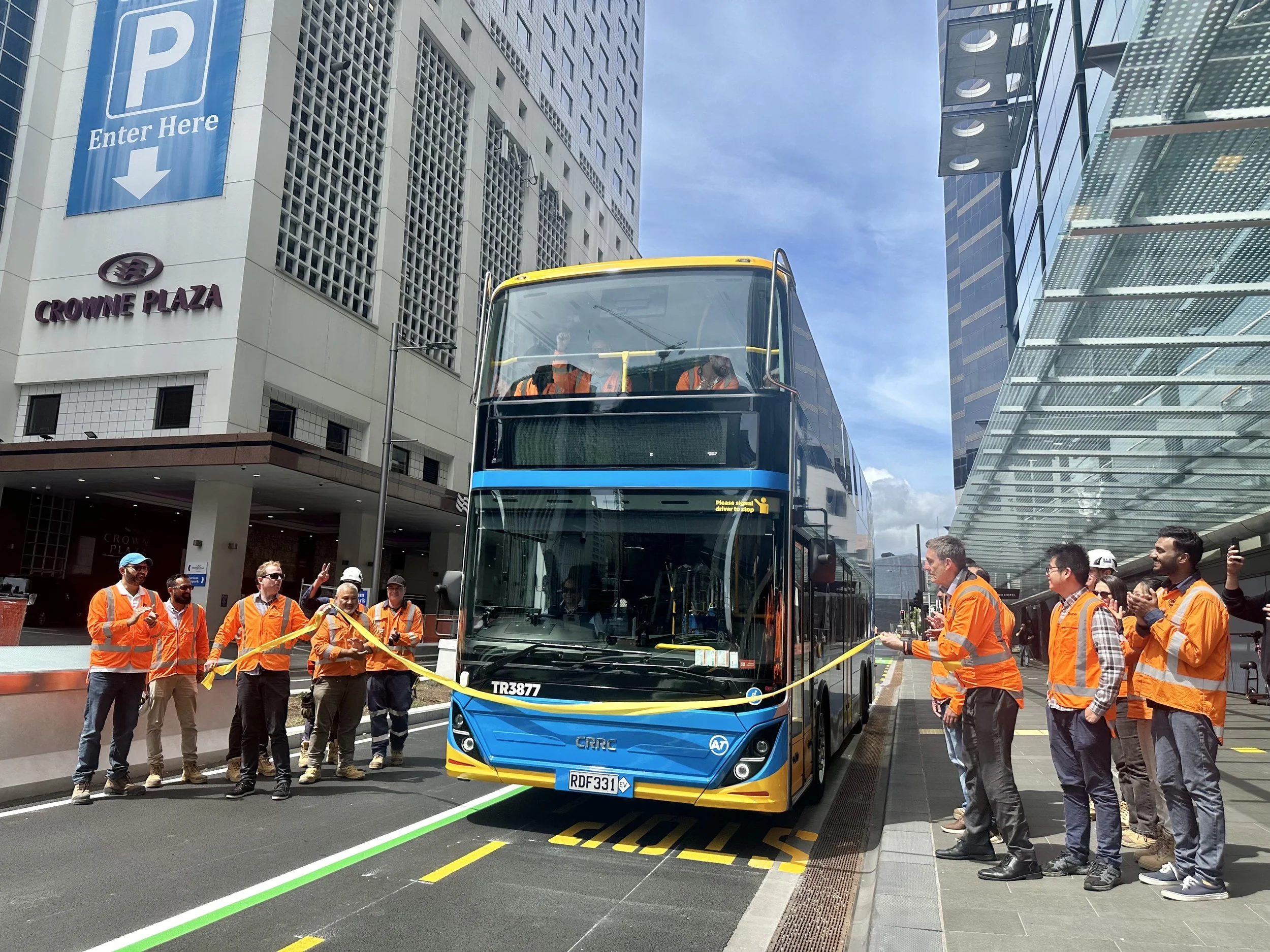
More than 200,000 cubic metres of rock and dirt was removed from Albert Street to build the new underground Te Waihorotiu Station and the twin tunnels lying beneath.
With station construction now largely complete, Albert St has been revamped with a new road surface including a bus and general vehicle lane in each direction, wider footpaths, new seating, and native trees. Seven large skylights – within the median strip of the road – draw natural daylight into the underground train station directly below.
“Getting Auckland moving is one of my key policies. Opening Albert Street for buses is a step towards the opening of the much-awaited City Rail Link, and another step to open up our city centre. We are starting to see real progress and it’s good that after many years of putting up with a ridiculous number of cones on city streets, we might start to see fewer cones and more people,” says Auckland Mayor Wayne Brown.
“While the CRL is being built, Council has also taken the opportunity to make other improvements in midtown, including upgrading infrastructure and public spaces. There are new private developments underway with further investment on the horizon. All this work will make it more attractive to come into the city.”
There'll be about 900 bus movements on Albert St each weekday – at peak this means a bus service every few minutes. Some of those buses will be double-deckers, capable of carrying up to 100 people, and many will be electric.
“Better links between buses and trains is a key part of our plan for a well-connected public transport network ahead of the CRL opening next year,” says Auckland Transport Director of Public Transport and Active Modes, Stacey van der Putten.
“Albert St will be at the heart of that. Te Waihorotiu is expected to become the busiest train station in Aotearoa, bringing people from across Auckland to a hub of jobs, entertainment, hospitality and culture – and to a seamless connection with frequent buses,” says Ms van der Putten.
Eight bus routes will use Albert Street, including the Western Express (WX1), frequent services 11T, 11W, and 18, as well as the 105, 106, 195 and 209. These routes will also use Vincent St and Pitt St, which have recently been upgraded by Auckland Transport.
Some construction will still be visible as work continues on projects including the Wellesley St improvements project, remaining CRL streetscape works, and further traffic optimisation projects. In the station, the focus is now on testing and commissioning.
“Albert St is just one piece of the puzzle, but every little step along this massive journey is an important one and I hope people can see we are on the verge of something great,” says Patrick Brockie, CEO of City Rail Link Ltd.
“We know some businesses in this area have done it tough, and we want to acknowledge them. Keeping roads and footpaths open during construction was a priority for us, as we set our sights on delivering something which will really help Auckland grow and prosper,” says Mr Brockie.
There’s plenty to travel for with a summer programme of events kicking off this weekend, starting with the Others Way music festival and the Santa Parade. Into December, Auckland Live venues in the Aotea Arts Quarter have an exciting programme of summer events lined up for Aucklanders and visitors alike to enjoy.
To check if your bus journey has changed, check the AT Mobile app or visit AT’s Journey Planner webpage.
Staying Connected: CRL Brings Mobile Coverage to New Rail Tunnels
28 October 2025
Aucklanders will be able to stay connected on their mobile phones and other devices when they use the City Rail Link (CRL), the country’s first underground railway, next year.
City Rail Link Ltd, its main contractor, Link Alliance, and telecommunications companies One NZ, Spark and 2degrees have begun installing the infrastructure that will bring both 4G and 5G high-speed mobile connectivity throughout the 3.45-kilometre-long CRL tunnels and at the new Te Waihorotiu, Karanga-a-Hape, and Maungawhau Stations.
“Installing technology that allows high-speed communications connectivity is an important part of delivering a world class railway for Aucklanders. Not only will passengers get to new places faster, but they will also be able to stay in touch, stream, and access information while underground” says City Rail Link Ltd’s Chief Executive Patrick Brockie.
One NZ is leading the installation of the physical infrastructure on behalf of all three network providers, supported by their technology partner Nokia. It is the first time the three mobile operators have collaborated to build a solution of this scale, ensuring continuous mobile coverage in the tunnels across their networks.
Besides keeping passengers connected, 5G also plays a vital safety role for the City Rail Link — helping protect people in the event of an underground incident.
“Connectivity underground is crucial for real-time train tracking, emergency communications, and integration of CRL with Auckland Transport systems that keep public transport running,” says Auckland Transport Chief Executive Dean Kimpton. “It will help to keep trains and passengers on time and online.”
One NZ and CRL Ltd say installing underground mobile infrastructure is a complex technical task, requiring careful coordination with the wider fit outs of the CRL station and tunnel systems.
“We're proud to be leading the design and implementation of the mobile network infrastructure for Auckland's underground transport network, helping to deliver a better-connected Aotearoa. Testing is complete, and our teams are now busy underground installing the system that will support modern urban transport and help Kiwis stay connected throughout their journeys,” says Thaigan Govender, One NZ General Manager Mobile Access Network.
Although cell coverage above ground is widespread thanks to cell towers, establishing it underground poses significant challenges. Solid materials such as concrete, steel, and earth used to build the CRL make it harder to provide consistent wireless connections.
The work involves the installation of a large amount of sophisticated hardware and software – over 350 radio transmitters connected by 74 kilometres of cabling, and 30 kilometres of leaky feeders (cables that transmit radio frequencies) – to ensure mobile coverage throughout the CRL tunnels and stations. Installation will continue into early next year and full coverage is expected when CRL opens in 2026.
Together, City Rail Link Ltd, Auckland Transport and KiwiRail are ensuring Auckland’s new world-class railway is ready to provide safe, reliable, and seamless journeys for passengers. There is still a significant amount of work to go, but the project is on track for opening in 2026.
CRL Timetable Testing Signals What’s Coming
22 October 2025 (Joint release with AT, KiwiRail, CRL)
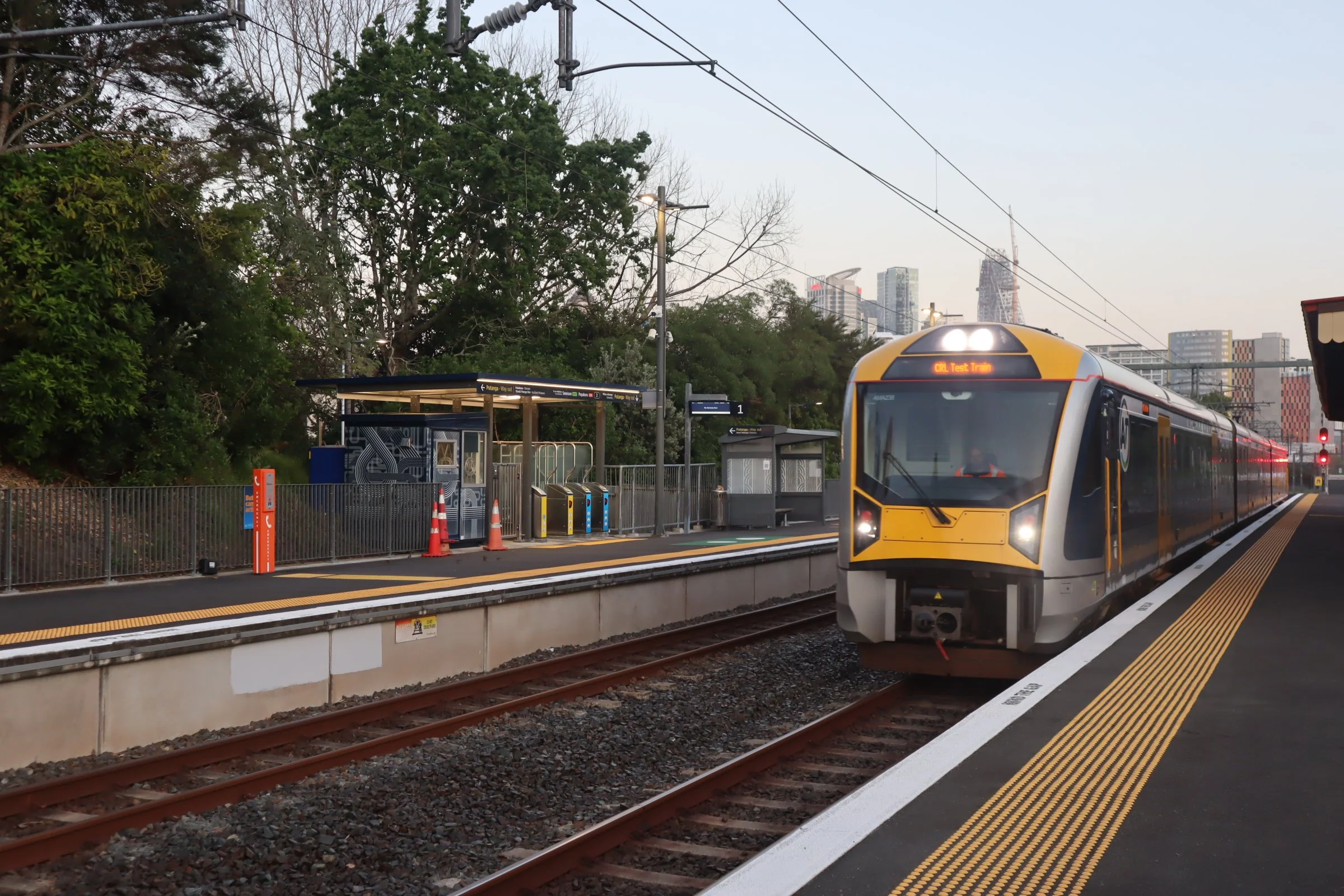
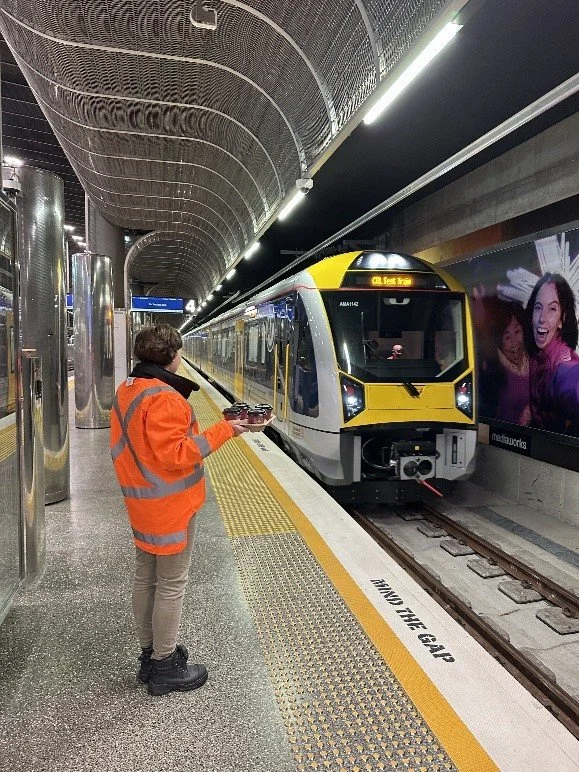
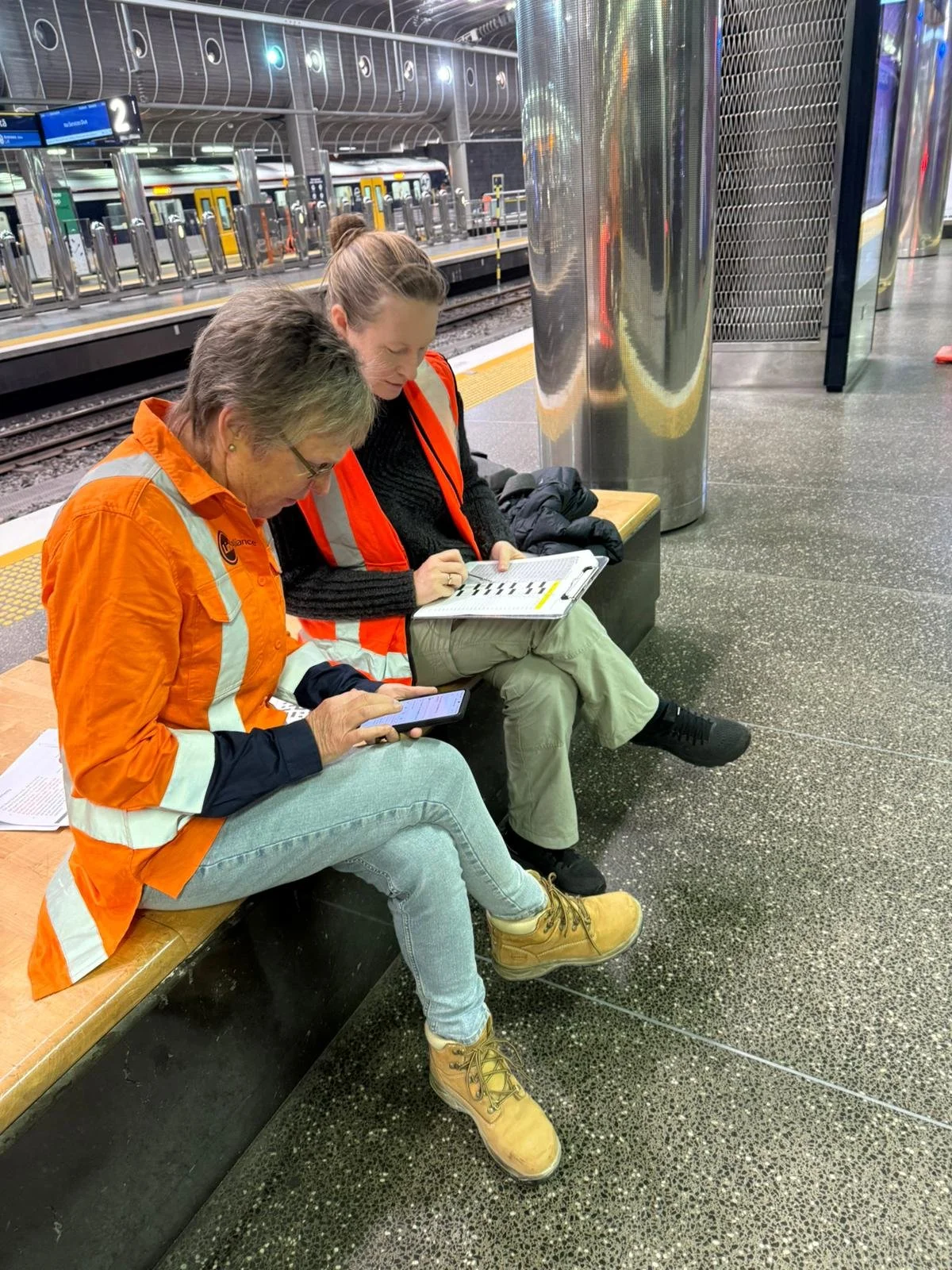
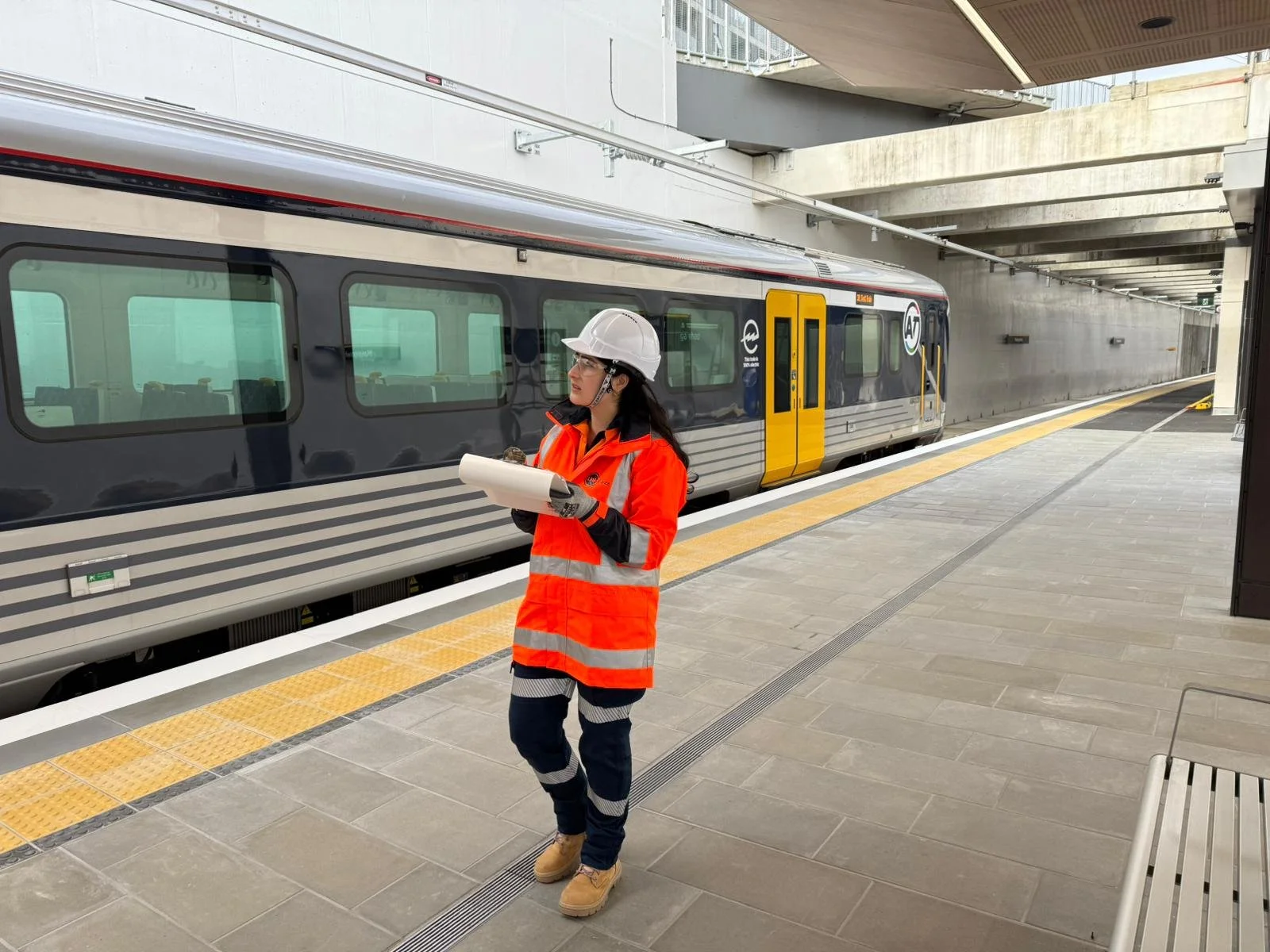
Photos
1) CRL Test train at Parnell Station
2) Coffee delivered to train drivers during breaks
3) Timekeepers monitoring train frequencies at Waitematā platform
4) Checks at Maungawhau Station
Testing of high-frequency train services has provided a glimpse into the future new City Rail Link (CRL) timetable, with trains venturing out of the tunnels and around the inner city “loop” for the first time to simulate the services people can expect from their new train network when the CRL opens in 2026.
“This testing is a great milestone. We learned more about how the CRL will function in our network, and we found things we need to adjust, but no big hurdles. We can now tweak the timetable before the next round of testing,” says Mark Lambert Auckland Transport Group Manager Rail Services.
Thirty-five drivers were involved in the testing, driving a combined total of 290 hours over the two days. It’s the first of several network and frequency tests for CRL, which will culminate in tests of the entire new rail timetable, operating across the whole Auckland metro network next year.
“It takes a lot of planning to carry out this sort of testing, with hundreds of people involved in the preparation and on the day across CRL Ltd, KiwiRail, Auckland Transport, its network operator Auckland One Rail and CRL’s main contractor, Link Alliance,” says City Rail Link Ltd Chief Executive, Pat Brockie. “We want to thank everyone for their hard work – from the timekeepers to incident controllers, the drivers, and operation and test management teams.”
During the testing, trains ran at a frequency of 18 trains per hour in both directions through the CRL tunnels and stations. The testing extended around a loop to Grafton, Parnell and Newmarket and along the Western Line as far as Kingsland. It’s a key step towards ensuring the CRL can perform as designed, and that Auckland Transport can operate the new train timetable with more trains, more often across Auckland.
“Eighteen trains per hour, per direction, is more than we’ll be running when CRL opens, but we need to make sure we test at maximum capacity,” says Mark Lambert. “It’s all about safety and reliability. The trains simulated a normal journey, stopping at all inner-city stations so we could check they stopped in the right places, that they were stationary for the right amount of time, and that there was a safe distance between trains as they trialled the higher frequency.
The testing was also extremely valuable for the drivers involved who for the first time experienced closely following other trains through the CRL tunnels, responding to sequences from the signals. During the testing, trains ran nearly 400 times through the new tunnels, clocking up 2500km over the entire route. “Running three minutes apart, the trains were being driven closer together than drivers are used to, and a big part of this weekend was to check that this could be achieved consistently,” says Lambert.
When the CRL opens next year, Auckland’s rail network will shift into high gear, with trains running every 4–5 minutes in the city centre during peak times, and increased frequency right across the rest of the network too.
About 90% of all trains services in Auckland will pass through the CRL on their journey connecting East, South and West directly to the city centre. KiwiRail City Rail Link Programme Director Bevan Assink says “KiwiRail was excited to work with our partners on this key milestone event providing train and overhead line control services and test monitoring via our rail and digital systems. We also had rapid response staff at key metro locations ready to restore the network if anything was required – happily the testing went very well!”
Another round of timetable testing is planned for the end of November. “This isn’t a one-and-done situation – testing the timetable in real life throws up lots of variables that often can’t be seen from our modelling. Repeated testing allows us to explore those issues and make adjustments as we go. It’s important to find this out now, so we can ensure smooth reliable journeys on day one, ” says Lambert.
“With that in mind, we want to thank customers for their continued patience. We really do understand that line closures and disruptions are frustrating no matter how important the work is. Thank you for bearing with us - we want to make sure we get this right so we can provide better journeys when CRL opens in 2026.”
Major rail upgrades during extended Labour Weekend closure
20 October 2025 (Joint release with KiwiRail and AT)
Major rail upgrades to enable more frequent, reliable trains and create safer access to train stations will be carried out during an extended Labour Weekend rail closure.
Auckland trains will not be running from Friday 24 October to Monday 27 October, allowing the 24/7 work needed to be ready for City Rail Link opening next year. It means crews can work safely and deliver more work on tracks and at stations during a shorter period.
Rail replacement buses will be ready and waiting to keep Auckland moving.
Auckland Transport Director of Public Transport and Active Modes Stacey van der Putten says the four-day closure maximises the amount of work that KiwiRail, AT and City Rail Link Ltd can get done.
This includes essential upgrades, renewals, overdue maintenance and multiple large-scale infrastructure projects, for example new pedestrian bridges at three stations to improve safety as train frequencies increase.
“We're grateful for people’s patience. We schedule this type of work as close as possible to long weekends to help reduce disruption as much as possible, and squeeze in as much work as we can.
“Don’t forget that Friday 24 October is still a normal workday for many people. Plan ahead to make travel as smooth as possible," Ms van der Putten says.
“Four days with no trains allows us to blitz the network safely, getting a huge amount done – we’ll be working 24/7 where possible as we make this final push to get the network ready for the increased services CRL will bring,” says David Gordon, Chief Metro and Capital Programme Officer at KiwiRail.
Labour Weekend also marks the start of construction at Glen Innes, Takanini, and Te Mahia stations to replace level crossings with pedestrian bridges. These bridges are part of Auckland Transport, KiwiRail and NZTA’s wider programme to keep increasing rail services by replacing level crossings across Auckland with safer connections.
Rail bus replacement services stop at or near all train stations on all lines – Southern (RBS), Eastern (RBE), Western (RBW) and Onehunga (RBO). Aucklanders are also encouraged to use regular scheduled buses to and from the city centre, such as #18 from New Lynn, #70 from Panmure and #30 from Onehunga.
Passengers can visit the AT website for detailed information on replacement bus routes, station-specific maps, and journey planning tools.
City Rail Link is the biggest and most transformational rapid transit development for Auckland. When it is finished, the city will have a better, more connected transport system, making it easier to connect with people and places.
Auckland Transport and KiwiRail thank Aucklanders for their patience and support as we continue to invest in a modern, high-capacity rail system for Auckland.
Works summary:
Rail Network Rebuild priority upgrades, renewals, and overdue maintenance focusing on central suburbs such as Parnell and Morningside and along the Western Line between Glen Eden and Swanson.
Network wide installation of new fibre and cables.
Ongoing construction of new Southern Line train stations in Drury.
Renewing rail assets such as the Parnell Tunnel.
Henderson Station third platform & emergency access bridge.
Remuera Station heritage signal tower refurbishment.
Newmarket Station weathertightness renewal and glass panel replacements.
Construction and site investigations for Glen Innes, Takanini and Te Mahia Station pedestrian bridges to replace level crossings.
Supporting NZTA’s bridge work at Drury.
Waitematā Station is getting a new jet fan for tunnel ventilation as well as new monitoring and safety improvement innovations.
In the City Rail Link, old fencing is coming down at key platforms, track is being evaluated, fresh signage and communications are going in, and improvements are being rolled out with testing underway.
Preparations for track adjustments to the North Auckland Line.
CRL returns much-loved square to the community
3 October 2025
After almost six years of construction, the City Rail Link (CRL) project is today returning a much-loved, new and improved community space to the Karangahape Road community when Beresford Square reopens.
“We know Beresford Square is an important focal point for the community and we’re delighted to return to them a vibrant plaza that is upgraded and people-focused,” says City Rail Link Ltd’s Chief Executive, Patrick Brockie. “Community support is a critical part of delivering a project successfully and I want to thank our fantastic neighbours for their patience and goodwill during many years of construction.”
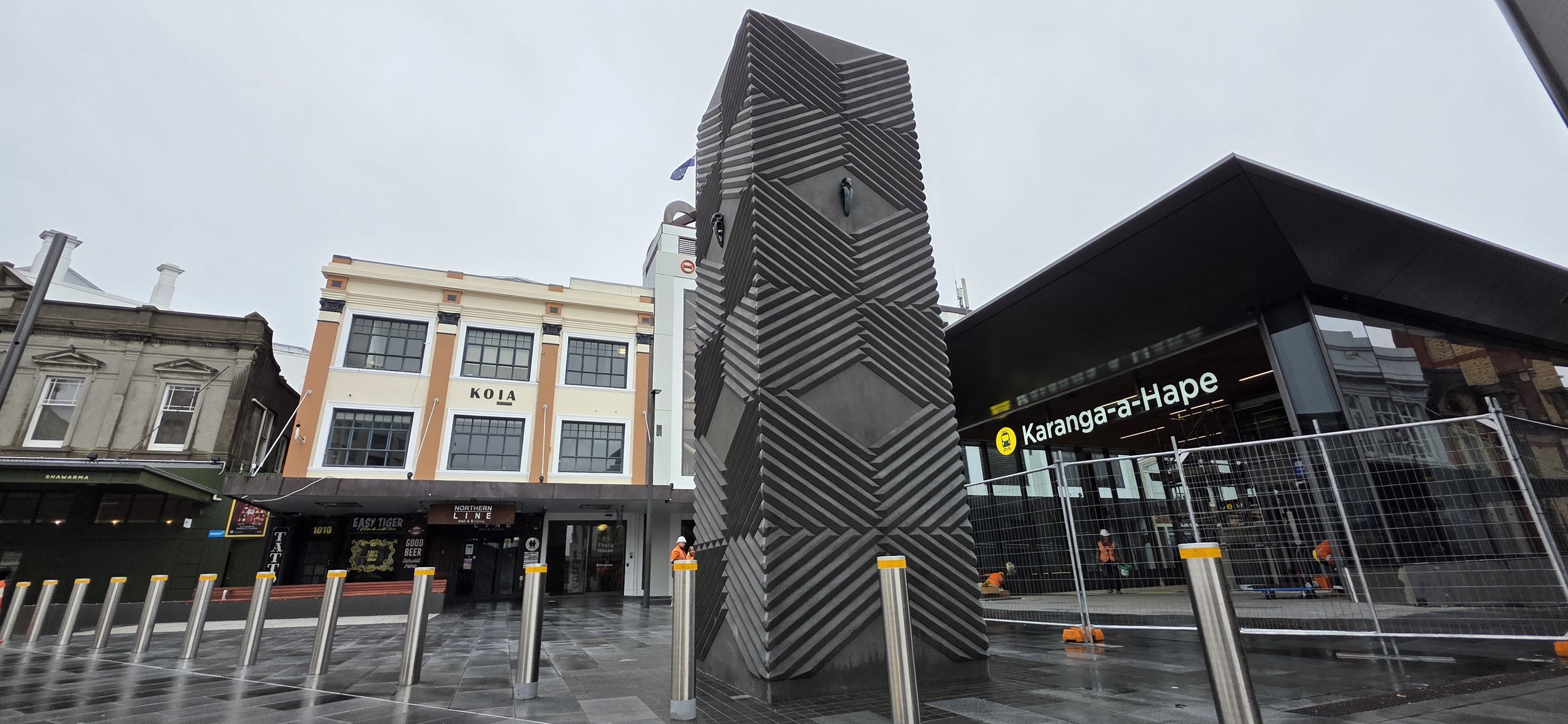
Over the years CRL Ltd, its lead contractor, Link Alliance, Auckland Council and Auckland Transport have collaborated with the Karangahape Road Business Association on the square’s revamp, complemented by streetscape upgrades across surrounding area.
“Auckland is becoming a truly connected city, and the opening of Beresford Square is the latest step towards a transport-friendly and transformed city centre – enabled by the City Rail Link project,” says Auckland Transport’s Jane Small, Group Manager Rail and Rapid Transit Infrastructure.
Beresford Square is one of two entrances to CRL’s Karanga-a-Hape Station (the other is nearby in Mercury Lane).
The entrance includes te ao Māori in its design, with the striking vent pou, bronze-cast manaia, and a maramataka installation that celebrates the Māori lunar calendar – all expressing a uniquely Tāmaki Makaurau identity. A dappled paver effect across the square represents Tāne Mahuta (god of the forest).
The upgrade also includes native tree plantings and a new retail space to open with the station next year, adding to Beresford Square’s character as the place to meet, socialise and shop. Auckland Transport has also been upgrading surrounding streets, with new cycleways, street furniture, trees, bus connections and resurfaced roads.
There will still be some ongoing low-level construction in the area as finishing works take place.
Locals will waste no time putting the upgraded square to good use.
“The Karangahape Road community is thrilled to see Beresford Square reopen. We invite all Aucklanders to celebrate with us and help bring the square to life at our First Saturday FAM market from 10 am tomorrow (Saturday 4 October),” says Jamey Holloway, General Manager of the Karangahape Road Business Association.
When CRL opens next year, passengers using Beresford Square will ride a 40-metre-long escalator - New Zealand’s longest – to get to and from Karanga-a-Hape’s platforms. The station will be the country’s deepest, 33 metres below ground.
Fencing will remain around the station entrance while extensive testing and commissioning continues below ground.
Ministers and Mayor ride CRL train under Auckland
8 August 2025
Auckland’s City Rail Link (CRL) celebrated an exciting milestone today, welcoming Prime Minister Christopher Luxon, Auckland Mayor Wayne Brown, Government Ministers, civic leaders and project partners as passengers on the transformational railway under the central city.
“The Government and Auckland Council are joint funders of the $5.5 billion project, and we’re delighted to have been able to show off the progress we are making and offer a preview of the benefits thousands of Aucklanders will enjoy when CRL opens next year,” says City Rail Link Ltd’s Chief Executive, Patrick Brockie.
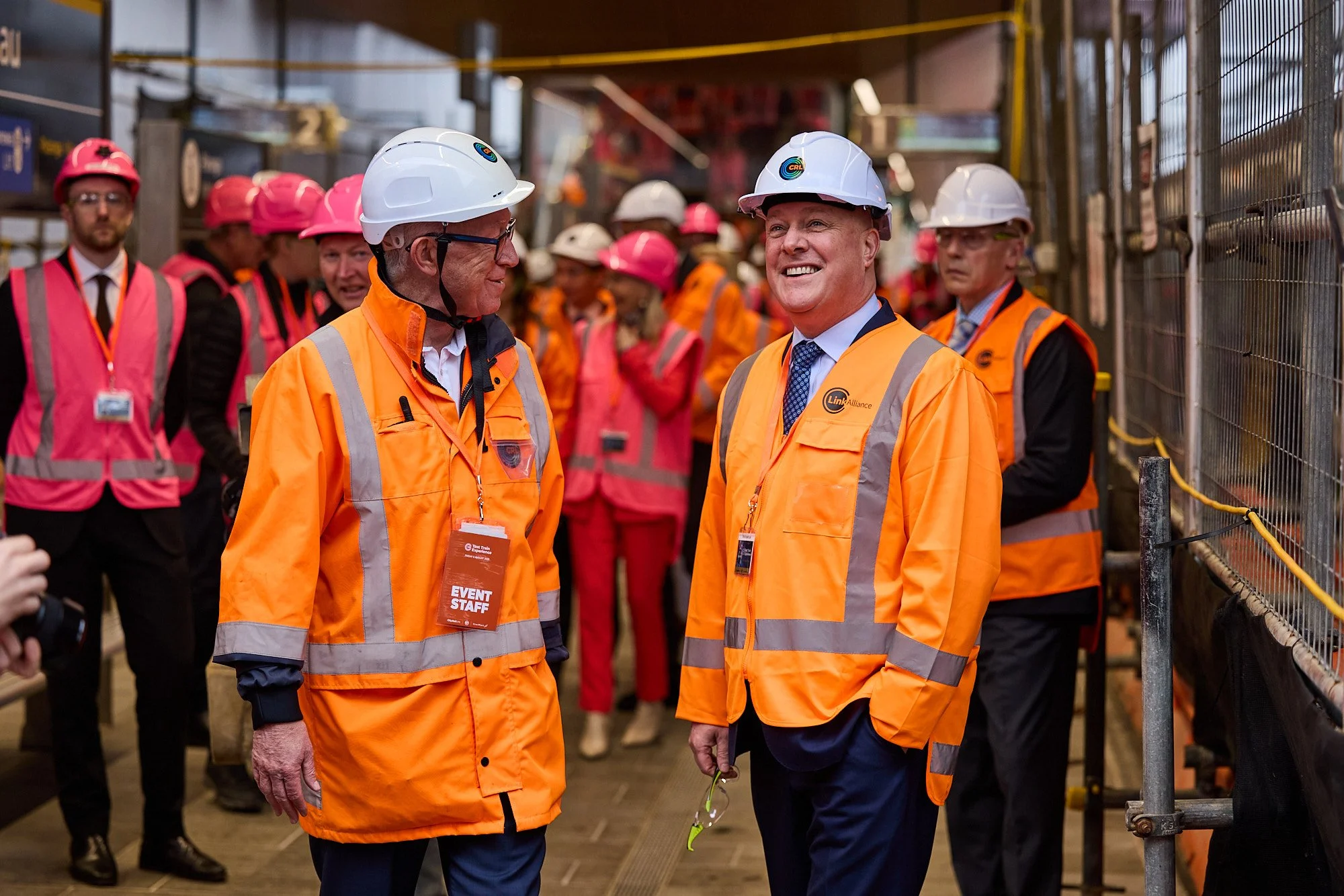
The train travelled beneath the city centre through the twin 3.45 kilometre-long tunnels, starting atthe new Maungawhau Station and passing through Karanga-a-Hape and Te Waihorotiu underground Stations and Waitematā Station (Britomart) before returning to Maungawhau.
Mr Brockie says with heavy construction complete, work is focused on commissioning and testing all the tunnel and station systems necessary to operate the CRL safely.
“While the finish line is getting closer, there is still a lot of work to be done before the CRL can open to passengers in 2026,” he says.
The trip was organised under strict safety protocols as part of the CRL’s rigorous train testing phase.
Since the first test train ran in February this year, more than 1,600 individual test train journeys have already taken place inside the tunnels and Mr Brockie says there is a lot more to do to ensure the CRL and future train services are safe and reliable.
“We know from lessons learned overseas, this is our most challenging and complex phase andgetting this right for Aucklanders is our utmost priority.”
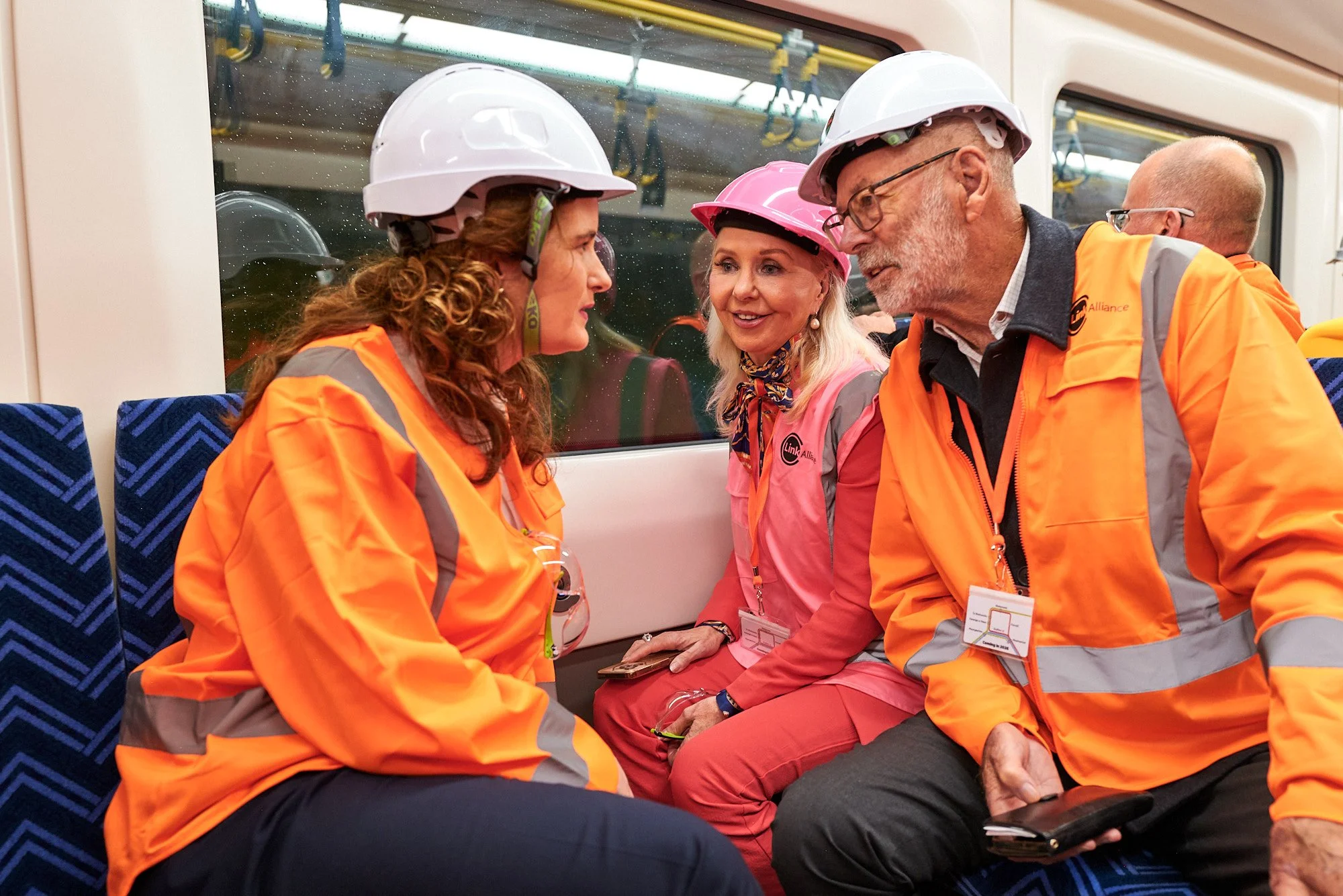
All project partners are working together to complete and open the CRL as quickly as possible to deliver the largest ever change to Auckland’s public transport network.
“We can’t wait to show more people just how transformational City Rail Link will be for Auckland’s wider rail network. It allows for a rethink of our train lines giving customers more choice in how the travel and ways get to where they’re going faster,” says Auckland Transport Chief Executive Dean Kimpton.
“There’s still a long ‘to-do list’ before we can open in 2026 and together with our partners, we are working hard to be ready for day one. We’re hiring front line staff, procuring new trains, updating bus routes, improving streets, paths and bus stops around our new stations and removing level crossings from our rail network,” says Dean Kimpton.
KiwiRail Chief Executive Peter Reidy says KiwiRail continues to deliver significant upgrades to the metro network to support the increased services City Rail Link will bring.
“In Auckland we are carrying out work which would normally take a decade but is being delivered in three to four years.
“While working closely with our partners to ensure rigorous testing and commissioning of the City Rail Link, KiwiRail is also modernising our older rail assets so they can support significantly more trains and passengers.
“We have delivered large new infrastructure projects to support this – Pukekohe to Papakura electrification, Third Main Line and Wiri to Quay Park, Western Power Feed – and continue at pace with the final stages of our Rail Network Rebuild and constructing three new stations in southern Auckland.”
CRL is New Zealand’s first underground railway.
Double bonus for City Rail Link’s “amazing achievement”
26 June 2025
Shifting the bar higher for New Zealand’s infrastructure industry has delivered a double bonus for Auckland’s game-changing City Rail Link (CRL).
The project has received two top-tier leading ratings from the Australian-based Infrastructure Sustainability Council (ISC):
An As-Built leading rating specifically for the design and construction of its main C3 tunnels and stations contract delivered by Link Alliance covering the work to build the Te Waihorotiu, Karanga-a-Hape and Maungawhau Stations, including its use of a tunnel boring machine between Maungawhau and Te Waihorotiu.
An As-Built leading rating for the overall CRL project covering the design and construction of C1, C2 and C3 contracts - CRL’s entire 3.45 kilometres route of tunnels and stations.
The CRL is now the first project to be awarded ISC’s Leading IS (Mahi Rauora Aratohu version 1) As Built programme rating overall. The entire CRL project—from Waitematā to Maungawhau - is now officially recognised as meeting the highest sustainability standards ever awarded in New Zealand.
ISC Chief Executive, Toby Kent, praised the CRL team’s “amazing achievement” and its commitment to the practice of sustainability.
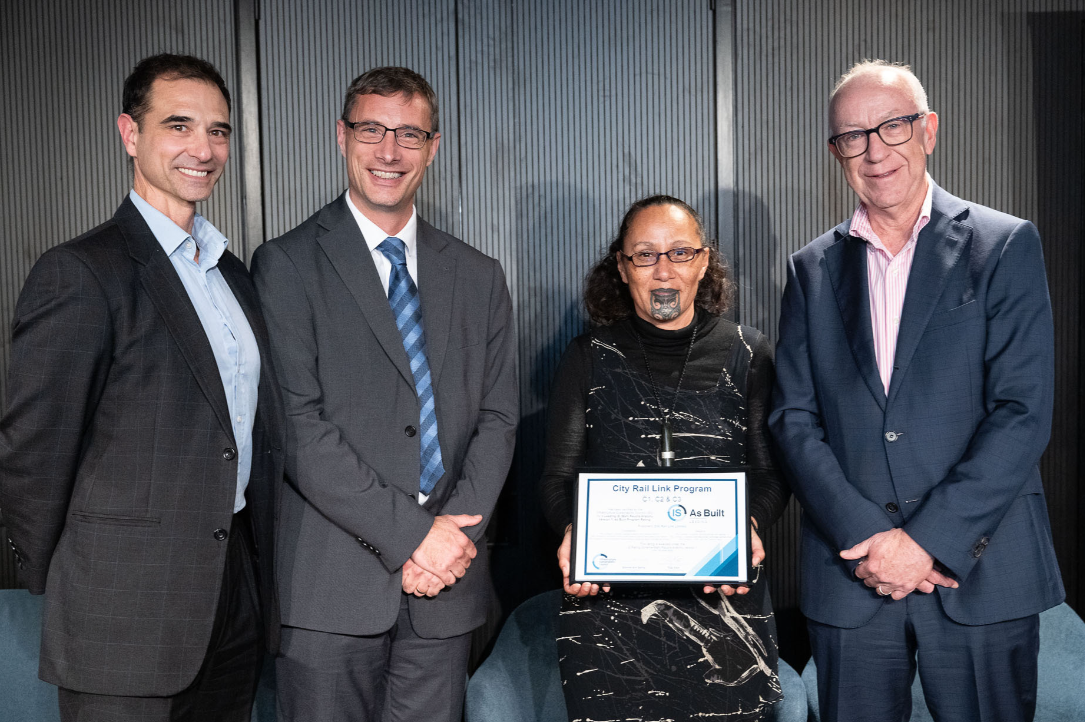
AWARD NIGHT: From left Toby Kent, Chief Executive of Infrastructure Sustainability Council, Doug Boddy, Link Alliance Environmental and Sustainability Manager, Edith Tuhimata from CRL’s Mana Whenua Forum, and Patrick Brockie, Chief Executive, City Rail Link Ltd.
“The ISC is proud to see New Zealand's biggest transport infrastructure project adopt sustainability into the DNA of its operations. This has been an amazing achievement and demonstrates the overwhelmingly positive social, economic and environmental good that is possible to achieve through an IS Rating," Mr Kent says.
CRL Ltd Chief Executive, Patrick Brockie, says the Council’s independent assessment is a powerful endorsement of the values and hard mahi adopted and demonstrated by the project, contractors and subcontractors from day one.
“Success for CRL Ltd and our Link Alliance delivery partner is testament to the passion, commitment, and tenacity of the many talented people who have delivered a project that is not just good for Tāmaki Makaurau Auckland, but good for the sector, shifting the needle on how we integrate sustainability, environment, social outcomes and culture into large scale infrastructure projects,” says Mr Brockie.
The Infrastructure Sustainability Council praised the commitment by CRL Ltd, Link Alliance and mana whenua to imbed Māori cultural values in the project’s design, and deliver positive social outcomes for Māori, Pasifika and rangatahi (youth) by creating employment and training opportunities and supporting Māori and Pasifika businesses with supply chain opportunities.
“Te Ao Māori has environmental sustainability at its very core,” says Edith Tuhimata from the project’s Mana Whenua Forum, “and we have an inherent responsibility to future generations for the way we conduct our businesses and the impacts that has on the environment and the people, if we take care of the Taiao (environment), the Taiao will take care of us. Mana Whenua bring a holistic approach to the CRL project to ensure whakapapa links are acknowledged and the best practical environmental, sustainable, social and cultural outcomes are achieved.”
Alongside positive social outcomes, the ISC was impressed by CRL’s protection of the environment: substantially reducing the project’s carbon footprint; savings around the use of construction and operational energy; more efficient use of water and materials; a dramatic reduction in waste earmarked for landfill; use of high-tech computer technology to help produce more efficient design and construction methodology.
Link Alliance Project Director Jean-Philippe Guillemenot says: “We’re proud of the environmental, social, cultural and economic outcomes achieved. The innovations developed by the team has left a legacy, many sustainability firsts for New Zealand, and new benchmarks for future infrastructure projects.”
Mr Brockie added that once operational in 2026, CRL will give Aucklanders more sustainable transport choices.
“We are determined to leave Auckland a better place than when we started construction and our success with the two Infrastructure Sustainability Council leading ratings certainly demonstrates that we are on the right track,” Mr Brockie says.
The contracts included in the ISC leading ratings are:
C1 - Waitematā Station (Britomart)/Lower Queen Street and Commercial Bay: designers Aurecon, Mott MacDonald and Jasmax; delivered by Downer and Soletanche Bachy Joint Venture
C2 – northern end of Albert Street between Customs Street/Commercial Bay and Wyndham Streets: designers Aurecon, Mott MacDonald, Grimshaw, Jasmax, Arup; delivered by Connectus (McConnell Dowell and Downer Joint Venture)
C3 - Main Tunnel, Stations, Western Line Connection and Rail Systems, delivered by Link Alliance (Vinci Construction Grands Projets, Downer, Soletanche Bachy, WSP, AECOM, Tonkin+Taylor and CRL Ltd)
Iwi represented on CRL’s Mana Whenua Forum: Te Ākitai Waiohua, Te Kawerau a Maki, Ngāti Maru, Ngāti Paoa, Ngāi Tai ki Tāmaki, Ngāti Tamaoho, Ngāti Whātua Ōrākei, Ngāti Te Ata Waiohua
Matariki Weekend rail closure – getting one step closer to CRL
One Client release
13 June 2025
Major rail upgrades to bring more frequent and reliable services mean no trains will be running from Friday 20 June to Monday 23 June 2025, as essential upgrade works are carried out across the city’s rail lines over the extended Matariki long weekend.
This closure across the Eastern, Western, Southern, and Onehunga Lines is needed so that KiwiRail, City Rail Link Limited and AT can continue vital network upgrade works ahead of the City Rail Link opening in 2026.
No trains will operate during this period, including on Monday 23 June, a standard weekday. People should also be aware there will be changes to train services during the upcoming winter school holidays.
To support passengers, AT will operate frequent all-stop rail replacement bus services throughout the rail closure period. For some passengers AT’s regular scheduled bus services will also be a good alternative.
AT’s Group Manager Rail Services Mark Lambert says closures like this are needed to get the wider Auckland rail network ready for the faster, more frequent train services that will come when the City Rail Link opens.
“We understand this closure will be disruptive—especially with Monday being a regular workday—but it is a necessary step to ensure the future reliability and efficiency of our rail network,” Mr Lambert says.
“We’ve timed this work over a long weekend to reduce disruption for our passengers as much as possible, and we’re doing everything we can to keep people moving.”
The upgrade work includes track renewals, foundation upgrades and drainage improvements as part of KiwiRail’s Rail Network Rebuild programme, the installation of fibre optic cables across the rail network, and maintenance work at train stations that would be too disruptive to undertake when services were running.
“The work AT and our partners are doing now will help unlock the benefits of the City Rail Link and transform how people move around our city,” Mr Lambert says.
We know that for many people this is likely to be frustrating. But this is a once-in-a-generation upgrade, so we’re asking Aucklanders to bear with us just a little longer so we can deliver a faster, more reliable, and more frequent rail service for everyone.”
KiwiRail Chief Metro and Capital Programme Officer David Gordon says: “KiwiRail is progressing works at pace especially on the Southern Line where we still have more to do to improve foundations and drainage to ensure our network is resilient.”
“Our teams will be working night and day to get as much completed as possible during the four days.”
Extended Matariki weekend rail closure
The extended rail closure over Matariki weekend extends from Friday 20 June to Monday 23 June.
Buses will replace trains on all lines, with all-stops rail replacement buses stopping at or near every train station.
Newmarket and Remuera stations will be fully closed during this period to enable work to progress more quickly on station maintenance projects.
Information for passengers about the closure and alternative transport options is being shared widely across AT’s customer communication channels and at stations.
The AT Journey Planner (on the AT Mobile app or AT website) is the easiest way for people to plan their journeys while train services aren’t running.
Partial rail closure during the winter school holidays
There will be also changes to train services from 28 June to 13 July during the winter school holidays.
Parts of the Southern Line will be closed for essential drainage works and reduced frequencies will be in place for the rest of the Southern Line, the Eastern Line, and the Western Line.
The Onehunga Line will retain its all-day 30-minute service during this period.
Rail replacement buses, including an express service will serve closed parts of the Southern Line as we do our best to keep passengers moving.
The City Rail Link will bring Auckland closer together
City Rail Link will double the number of Aucklanders within a 30-minute train journey to the central city and increase rail capacity by at least 50 per cent on its opening day.
It will also significantly cut journey times – for example Henderson to the city centre in just 35 minutes (save 24 minutes). Another example is Maungawhau Station (formerly Mt Eden) to Waitematā (Britomart) in under 10 minutes, which is about half the current time.
Trains will run more frequently - every four minutes through the central city, every five minutes from all stations north of Puhinui on the Southern and Eastern Lines, every 8 minutes on the Western Line from Henderson and every 10 from Pukekohe.
Successful CRL train test signals Auckland’s bright future
13 February 2025
A giant, slow step in a journey that will transform travel in New Zealand’s largest city was completed successfully last night when a test train made its first trip through the full length of Auckland’s City Rail Link (CRL) tunnels.
The 3.45-kilometre-long inaugural journey ran south from Waitematā Station (Britomart) under central Auckland past the new underground stations at Te Waihorotiu and Karanga-a-Hape to Maungawhau Station on the Western/North Auckland Line.
The three-carriage train left Waitematā station on time at 9pm and took two-and-a-half hours to complete its first journey. The speed was deliberately slow – around five kilometres an hour – allowing technicians to complete their first round of underground checks and balances relating to tunnel clearance, power supply and signalling. The train successfully completed five trips during the night.
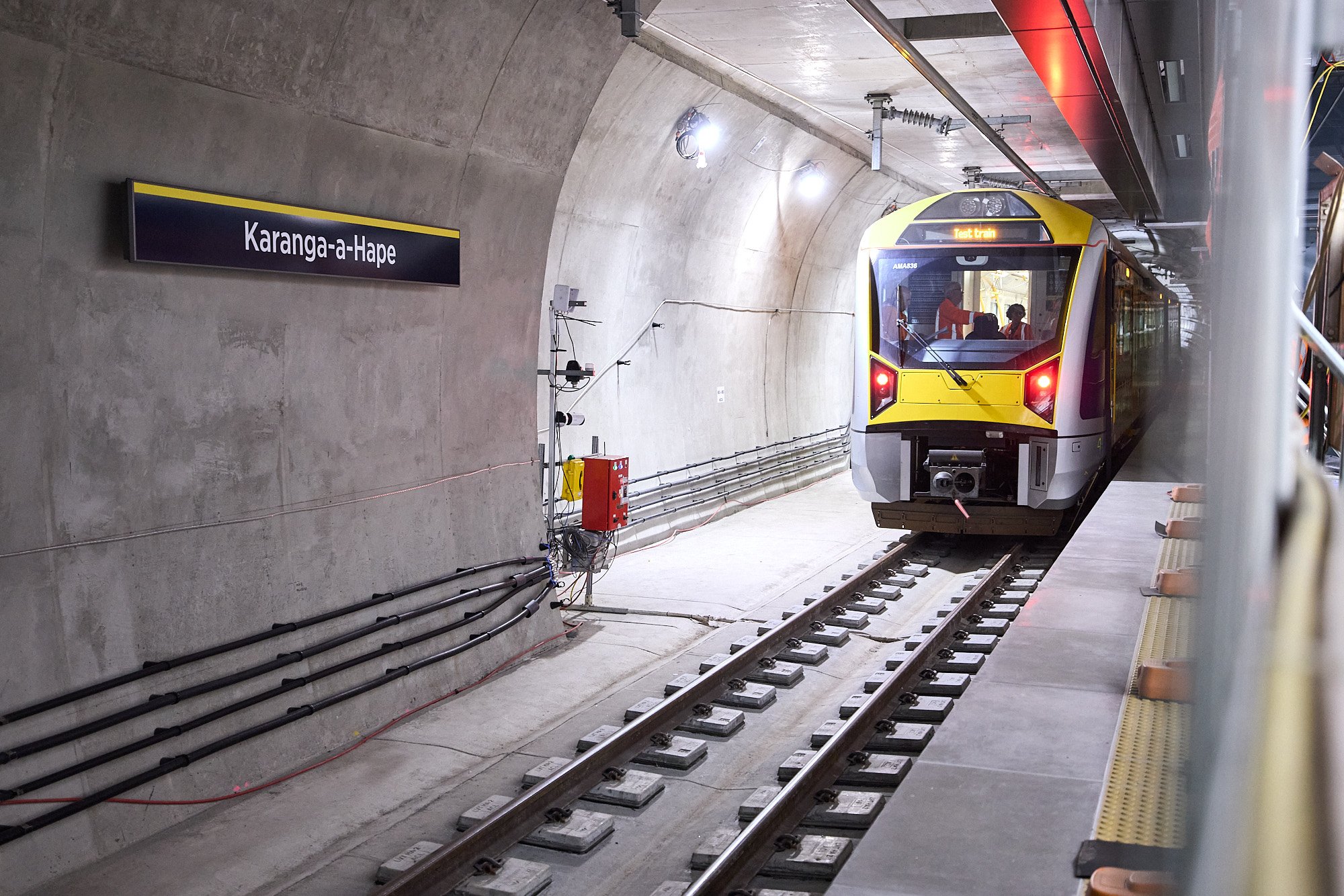
The successful test run is welcomed by Auckland Council which, along with the Government, funds New Zealand’s largest transport infrastructure project.
“This is momentous for Auckland and the City Rail Link programme, which has had its fair share of challenges,” says Mayor Wayne Brown. “It’s good to see progress being made because Auckland deserves a public transport system that will deliver benefits for Aucklanders and visitors alike. I’ve always said I was determined to get the project finished and over the line, and we can finally see the light at the end of the tunnel.”
Getting the green signal to proceed came after exhaustive planning and safety checks that peaked last week when the tunnels’ overhead lines were energised ready to provide the electricity to power trains.
City Rail Link Ltd’s Chief Executive, Patrick Brockie, described the journey as a “colossal milestone” that the project had been working towards since spades first went in the ground at Britomart in 2016.
“City Rail Link Ltd was established to deliver NZ’s biggest infrastructure project – one that will be an absolute gamechanger for Auckland. Last night’s test run is a major step in our transition from a construction site into a railway and we now start a comprehensive testing schedule ahead of people riding the train next year,” says Mr Brockie.
CRL is a new rail connection that turns dead-end Waitematā into a through line station to better connect the central city and the wider rail network.
KiwiRail says the first end-to-end journey launched a key testing phase to confirm trains can seamlessly transition between CRL and the wider network.
“This is a huge milestone for the CRL project and all our partners. We’ve all worked tirelessly to get to this point and seeing a train make its first journey through the full length of the tunnels is true cause for celebration. Last night’s first end-to-end journey launches the key ‘dynamic’ train testing phase of the CRL project to confirm that trains and the CRL infrastructure can seamlessly integrate with the wider KiwiRail network,” says Bevan Assink, KiwiRail’s Programme Director City Rail Link.
“These tests will accelerate in the coming weeks. This includes brake testing on what is one of the steepest sections of railway in New Zealand, recovery procedures and the start of hands-on training for drivers. The start of CRL dynamic testing in the tunnels closely follows another key milestone - the successful completion of KiwiRail’s latest stage of its network upgrade programme, where significant progress was made with major network rebuild works over the summer holidays,” says Mr Assink.
Auckland Transport director public transport and active modes Stacey van der Putten says: “When City Rail Link opens in 2026 it will better connect Aucklanders to the people and places they want to visit. For the first time the rail network is joined up for trains at the heart of our public transport system."
“The test train has made the first direct, easier journey that tens of thousands of people will be making every day. But before that happens, we’ve still got a lot of work to do to make sure journeys on Auckland’s new railway are safe, reliable and seamless from day one,” says Ms van der Putten.
Running trains through the tunnels is but one part of a busy schedule of tests and checks working to ensure Aucklanders can use a world class rail system in 2026. Work includes testing complex tunnel ventilation systems, tunnel supervision and security, lighting, upgraded communications, and providing hands-on training for Auckland’s metro drivers and station staff – and many more.
“At all times,” Mr Brockie says, “safety is our absolute priority.”
Mr Brockie acknowledged the work of his CRL Ltd team, the project’s main Link Alliance contractors, KiwiRail, Auckland Transport and Auckland One Rail.
“Everyone involved in being ready for the first train has the right to be proud – a great achievement that demonstrated the very best in innovation and co-operation to deliver an outstanding outcome for Auckland and its more accessible future,” he says.
First test train journeys through City Rail Link
Hon Chris Bishop, Hon Simeon Brown
A test train has now completed its first trip through the full length of the City Rail Link (CRL) tunnel in Auckland, representing a critical step forward in this game-changing public transport project for our largest city, Transport Minister Chris Bishop and Minister for Auckland Simeon Brown say.
“Started under the previous National Government, CRL will double Auckland’s rail capacity and reduce congestion when it opens in 2026, enabling Aucklanders to get to where they want to go quickly and safely meaning a more productive Auckland. There is still a lot more work to do, but it’s great to see measurable progress being made on site as we countdown to the CRL opening next year,” Mr Bishop says.
“The CRL tunnel’s overhead lines were energised last week, enabling power to be provided to trains in the tunnel. The first test train ran a 3.45km-long journey last night, from Britomart Station to Mt Eden on the new underground section of railway, the first train to travel on a brand-new rail line since 2012.
“This important test train allowed technical experts to complete their first round of testing relating to tunnel clearance, power supply and signalling. Further testing will ramp up in coming weeks, including brake testing, recovery procedures, tunnel ventilation systems, supervision and security systems, lighting, communications, and the start of hands-on training for Auckland’s metro drivers and station staff, among many others.”
“CRL will be a gamechanger for Auckland’s public transport network, turning Britomart from a dead-end station into a through station, enhancing connections between the central city and the wider rail network,” Simeon Brown says.
“The first train through CRL is an important milestone for the project. Once complete, CRL will result in significant time savings, and make public transport a much more viable option for Aucklanders.”
“This is momentous for the City Rail Link programme and Auckland ratepayers who have made a significant contribution, alongside government, to get this project completed,” says Mayor Wayne Brown.
“Our city deserves a public transport system that will deliver for Aucklanders and visitors alike. I’ve always said I was determined to get the project finished and over the line, and while the project has had its fair share of challenges and there are lessons we’ll take from it, I’m pleased to see that progress has been made and that we can finally see the light at the end of the tunnel.”
“I want to acknowledge the hard work and dedication of everyone involved in the CRL project to get us to this point. There is a lot more work to do, but today represents an important milestone in moving from a construction site into a railway,” Mr Bishop says.
“Tens of thousands of Auckland commuters are right behind you, and they’re looking forward to experiencing the benefits your hard work will deliver when CRL opens next year.”
Note to editors:
Once operational, City Rail Link (CRL) benefits for Auckland passengers at peak times include:
On the Southern Line – trains every 5 minutes (compared to 10 minutes currently) north of Puhinui, every 8 minutes between Papakura and Homai, and every 10 minutes between Pukekohe and Drury
On the Eastern Line – trains every 5 minutes between Sylvia Park and Ōrākei
On the Western Line – trains every 8 minutes between Swanson and Maungawhau
Subject to Auckland Transport confirming train timetables, the combination of using the CRL tunnel and reduced temporary speed restrictions are expected to see:
Maungawhau (Mt Eden) to Waitematā (Britomart): under 10 minutes (half the current time)
Kingsland to Waitematā (Britomart): 13 minutes (8 minutes faster than currently)
Henderson to Waitematā (Britomart): 38 minutes (8 minutes faster than currently)
First CRL test train set to start
12 February 2025
Auckland’s City Rail Link (CRL) is set to start testing trains in the project’s tunnel overnight tonight (February 12/13) pending final checks being successfully completed.
The planned start of running test trains through the tunnel follows two significant milestones: the successful energisation of the tunnel’s overhead electric lines earlier this month, and the official handover of the new tunnels and track for train testing to KiwiRail in the early hours of this morning.
City Rail Link Ltd’s Chief Executive, Patrick Brockie, says testing trains in a ‘live’ tunnel is an exciting milestone that starts the transition of the project from construction site into a railway.
“We’ve been working towards this milestone since construction began and it’s exciting to see the project getting closer to being able to deliver the significant benefits Aucklanders can expect when it opens.”
Mr. Brockie adds that tonight’s train running is the first of a comprehensive testing programme that will start with trains running slowly – with safety at the forefront.
“Safety is the absolute priority. New Zealand has limited experience with this phase of the project, particularly in a tunnel. We are dealing with 25 thousand volts of electricity and before the first test train drives into the tunnel, we have to ensure the safety of everyone involved,” Mr Brockie says.
The test train’s 3.45 kilometre journey overnight between the Maungawhau and Waitematā (Britomart) Stations will be deliberately slow – around five km/h – to allow technicians on board to complete their first round of checks underground.
Tonight marks the start of an extensive programme of train testing that will accelerate in the coming weeks and continue right up until opening.